
In the late 1990s, the internet still looked rather like a library in which someone had switched off the lights, overturned the catalogue cabinet, and then announced optimistically:
— There you are. All of human knowledge.
Good luck.
It had everything. Academic research, cat pages, conspiracy theories, recipes, pornography, Shakespeare, UFOs, railway timetables, personal websites with blinking text, and background music sufficiently offensive to justify temporarily suspending the internet while the page was still loading.
The only difficult part was finding anything.
Then two Stanford PhD students, Larry Page and Sergey Brin, began working on a search engine. The idea was almost touchingly simple: instead of looking only at the words on a page, it would also look at how that page connected to others. It would try to impose some order on what humanity had previously thrown together with considerable enthusiasm.
On September 4, 1998, Google Inc. was incorporated.
And the world received a blank white page.
A box.
You typed something into it, and the box answered.
At the time, this genuinely felt like magic.
There is no need, in retrospect, to pretend that every technological advance arrives as part of some sinister plan, with evil billionaires stroking server farms somewhere in the background. Google spread because it was good.
Fast.
Simple.
Useful.
It found books, addresses, people, recipes, historical facts, illnesses, restaurants, and, naturally, old lovers — strictly for academic purposes.
People occasionally searched for themselves as well. It was one of the digital age’s earliest exercises in self-knowledge.
Then they felt faintly offended if the internet knew less about them than they had hoped.
Search was free, too.
That word has always had a wonderfully calming effect on modern humanity. If no money changes hands, we tend to feel that asking how the business model works would be rather impolite. A gift should be accepted graciously, and terms and conditions agreed to without spoiling the festive atmosphere by actually reading them.
But there was already an interesting distinction.
We were searching for something.
Google, meanwhile, was learning what we were searching for.
The first piece of information was useful to us.
The second was useful to Google.
And, in time, the second turned out to be remarkably valuable.
Because a search is not merely a question.
It is also intent.
Type “used Volvo” and, in the language of commerce, the vague outline of a potential car buyer already begins to appear. Search for “beach hotel September” and there is a monetisable desire taking shape. Type “good divorce lawyer” and somewhere the modern economy nods sympathetically and pulls its chair a little closer.
Then, in 2004, Google went public.
Search remained free.
The company, however, was worth billions.
By then it was becoming fairly obvious that somebody was paying.
Just not necessarily the person doing the searching.
It was a more elegant business model than charging admission. The real question was how much it was worth to know what someone wanted at the exact moment they revealed it.
Then Google slowly moved out of the search box.
It moved into email. Maps. Phones. Browsers. Videos. Our routes through the world.
And somehow it became normal.
In the morning, we check the weather, then how long the journey to work will take. On the way, we search for the email we distinctly remember someone sending, although we cannot remember who or when. Before lunch, we check restaurants. In the afternoon, we search for a sentence we once read somewhere. In the evening, a film, a book, a person, and finally a symptom which is hopefully nothing — although after the first three search results we have already begun, very quietly, to put our affairs in order.
And all this happens on one entirely unremarkable Tuesday.
Google stopped being somewhere you occasionally went.
It became background.
Rather like electricity: you mostly notice it when it is gone.
Once, people asked Google where something was.
Now they sometimes search through the settings to stop Google knowing where they are.
The search engine, meanwhile, has made itself comfortable. It remembers the hotel you looked at the night before, purely out of curiosity. It knows which video held your attention eight minutes longer than you intended. It helps you find the email you wrote yourself but can no longer remember where you put it.
A spouse possessing this much information might already be considered mildly disturbing.
With a technology platform, we call it user experience.
And most of it is genuinely convenient.
Nobody particularly wants to return to paper maps. Few of us miss the telephone directory. Nor do we yearn to stand in an unfamiliar city asking three strangers for directions, two of whom confidently send us the wrong way while the third points left only because that happens to be where he parked his car.
Which is why it is difficult to be properly angry with Google.
It is too useful.
One of the more refined forms of modern dependence begins when something makes life so much easier that it begins to feel almost impolite to ask what it wants in return.
And we leave things behind.
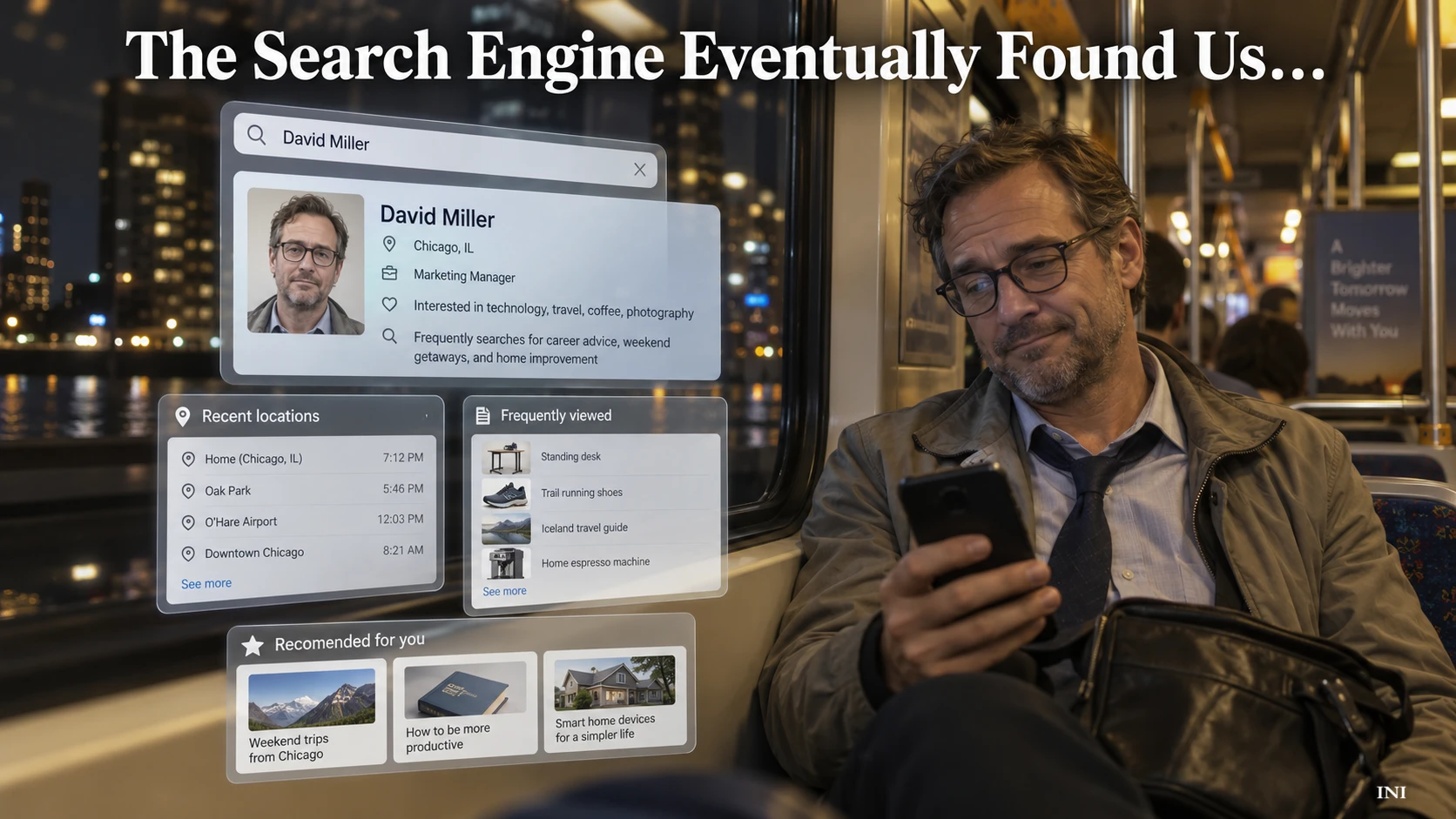
Searches, locations, clicks, interests, small digital traces. None of them is particularly interesting on its own. Together, however, they begin to draw a person who looks disconcertingly familiar.
Perhaps more recognisable than the carefully edited person presented in the résumé.
Because people lie in résumés.
They lie less often to the search box.
There they admit what frightens them. What they want to buy. Where they want to go. What symptom they have. Whom they are looking for. What they do not understand. And what they would feel slightly embarrassed asking another human being.
Search history is therefore a peculiar form of unintended autobiography.
Somewhere between a diary, a shopping list, and a confessional.
Except that confessionals did not traditionally hold real-time advertising auctions.
From there, it was not much of a leap for the system to stop being satisfied with what we search for.
It began trying to guess what we would search for next.
It finishes the sentence, sometimes after the third word. We begin with a thought, and the system places several possible endings in front of us. Some are disturbingly accurate. At other times, it merely reveals that several hundred thousand people have already asked exactly the same stupid question.
At least nobody is alone in stupidity.
But something more important happens here.
Search rankings, autocomplete, recommendations — these do not merely answer curiosity.
They also give it direction.
At first, we asked:
Where can I find it?
Later:
What do you recommend?
The difference does not seem enormous.
Except that in one of them, we still knew what we were looking for.
Once, we had to formulate the question ourselves. Now we receive assistance with that as well.
If a system recommends something often enough, we may discover that it interests us before it has even occurred to us that it might.
Google’s original promise was a beautiful one: to organise the world’s information and make it accessible.
It largely succeeded.
But along the way, something became clear.
We, too, were part of the world’s information.
Our curiosity.
Our movements.
Our attention.
Our habits.
Our plans.
The search engine became increasingly good at finding what we were looking for. Then it learned why we were looking for it. Later, it learned what might interest us next.
We thought we had been given a tool for navigating the world.
And we had.
Along the way, we became increasingly easy to navigate as well.
We were not merely asking the system questions.
Search by search, we were answering questions it had never needed to ask.