
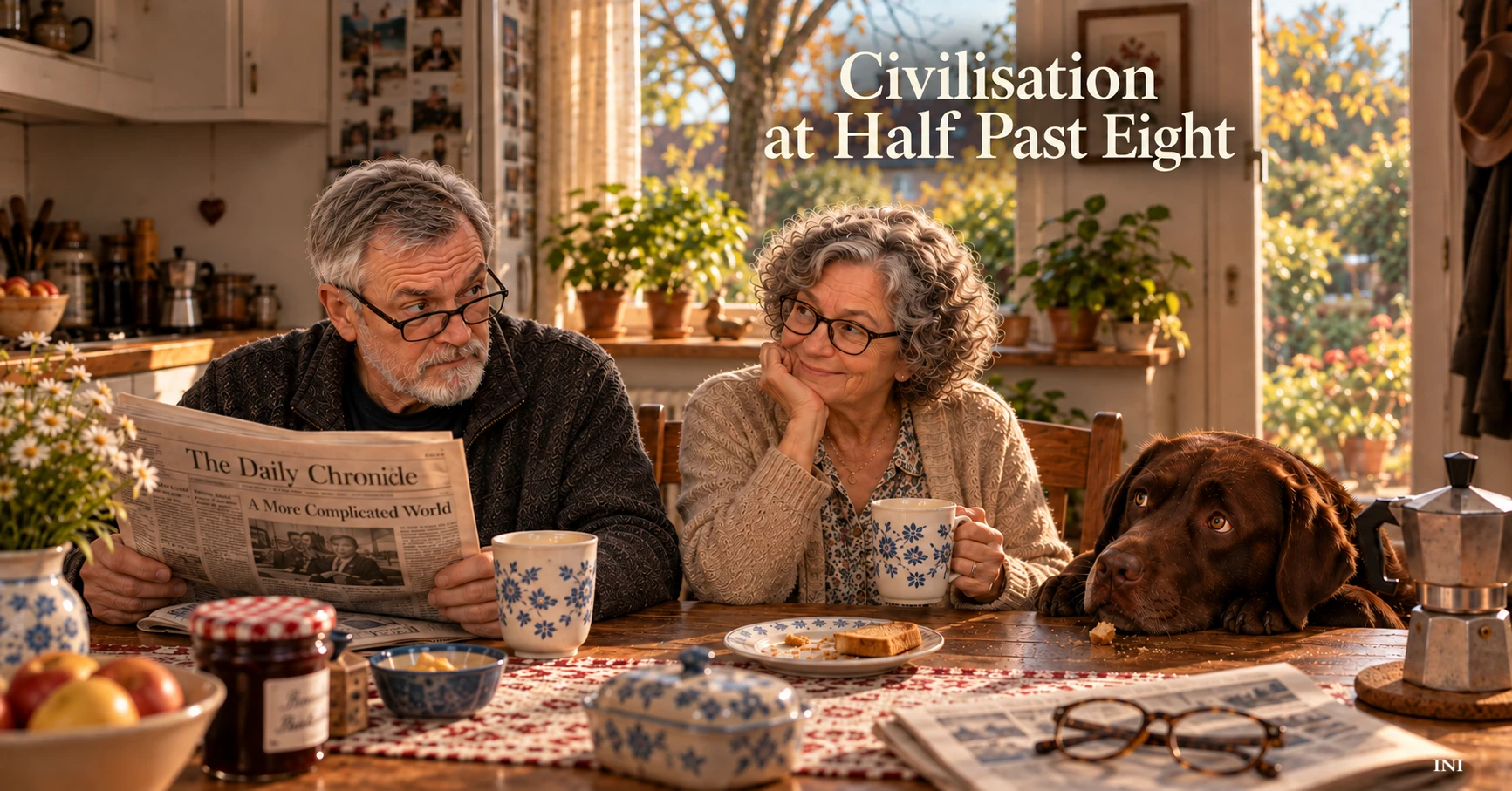
Henry’s toast had disappeared.
Not half of it.
Not because he had put it somewhere else.
Not because Margaret had accidentally eaten it.
It simply wasn’t there.
Henry stared at the empty plate for a few seconds, then at Brutus.
Brutus stared back.
The chocolate Labrador wore the wounded dignity of someone who had been accused without evidence and was hoping nobody would notice that he was still chewing.
“Brutus.”
The dog didn’t move.
Henry leaned closer. His grey hair had long since given up any attempt to remember its original colour, and behind his thick glasses appeared the look Margaret knew well: something had happened, and Henry intended to establish responsibility.
“Don’t look at him like that,” she said from beside the coffee maker.
“Like what?”
“Like a policeman who already has the culprit.”
“I do have the culprit.”
“You don’t have proof.”
“He’s chewing.”
Brutus stopped chewing.
A little late.
Margaret poured the coffee.
Her curly silver-grey hair framed her face as though gravity had never quite managed to impose its authority on it. Behind her large round glasses, she regarded the world with affection, curiosity and the calm suspicion that, given enough time, people would usually reveal something ridiculous about themselves.
Henry was by no means the only example.
They were both retired now, and mornings had become pleasantly unhurried.
Henry had discovered that retirement left him considerably more time to read the news, inspect the garden and notice things that, in his opinion, other people were doing incorrectly.
Margaret had discovered that she had considerably more time to observe the same world from a slightly different angle.
And, when necessary, Henry.
The old coffee maker sputtered on the counter. It had stood there for twenty-one years and had acquired two scratches, a slightly melted piece of plastic and a button that only worked if pressed first to the left, then down, with a certain amount of determination.
Henry loved it.
Margaret had made peace with it.
Robert had been trying to replace it for years.
“Would you like another piece of toast?” Margaret asked.
Henry was still watching Brutus.
“That’s not the point.”
“I know.”
“It’s about trust.”
“Of course.”
“We live under the same roof.”
“For more than thirty years.”
“I was talking about Brutus.”
“I know.”
Henry adjusted his knitted cardigan. There were several like it in the wardrobe, though Henry insisted they were all completely different.
“You give him a home. You feed him. You walk him. You take him to the vet. He even gets presents at Christmas.”
Margaret took a sip of coffee.
“You got socks last year.”
Henry looked at her.
Brutus lay down beside the table.
For him, at least, the matter appeared settled.
The doorbell rang.
Margaret glanced at the clock.
Half past eight.
“John.”
“It could be anyone.”
The door opened.
John walked in.
He was middle-aged and slightly balding, although he preferred to say that his hair had become “a little thinner at the front”. Henry occasionally pointed out that the same appeared to be happening at the back, which John regarded as unnecessary commentary.
John himself had no objection to commentary in general.
He was fond of adding something to almost any conversation, whether the subject was the weather, politics, lawn mowing or something he had only just been told about.
“Have you got a thirteen-millimetre spanner?”
Margaret looked at Henry.
Henry looked at Margaret.
“You’re not going to say anything?” he asked.
“What would be the point?”
John took off his coat and sat down at the table as naturally as if he lived there.
Over the years, a familiar routine had developed. John arrived because he needed to borrow something. Margaret gave him coffee. Henry asked about the last thing he had borrowed. John said he still had it. Henry then asked why he needed another one.
This usually took care of the first ten minutes.
“I lent you a spanner last year,” Henry said.
“That was a twelve.”
“And where is it?”
“At home.”
“Then why don’t you use it?”
John looked at him.
“Because I need a thirteen.”
Henry removed his glasses and rubbed the bridge of his nose.
Margaret pushed the sugar towards John.
“Don’t strain yourself.”
John glanced at Brutus.
“What’s wrong with him?”
“He robbed me.”
“He was hungry.”
“He’s always hungry.”
“He’s a Labrador.”
“That’s not an excuse.”
John took a sip of coffee.
“No. But it does explain quite a lot.”
Margaret smiled.
Brutus opened one eye, then closed it again.
The front door opened.
“Hi!”
Lucy’s voice arrived just before she did.
She was around thirty, blonde, blue-eyed and energetic in a way Henry found tiring even when she was standing still. Her hair was loosely tied back, her sunglasses were pushed up on her head, and a canvas bag with an environmental slogan hung from one shoulder.
Lucy kept up with things.
New diets, new apps, new habits, new reasons why something people had been doing perfectly happily for decades had suddenly become questionable.
She meant well.
Henry was not always convinced that this improved matters.
“I brought you something.”
He leaned back in his chair.
“We don’t need it.”
“You don’t even know what it is.”
“That’s why I’m being cautious.”
Lucy reached into the bag and produced a carton.
“Oat milk.”
Henry looked at it.
Then at Lucy.
“What am I supposed to do with that?”
“Drink it.”
“Why?”
“Because it’s better.”
“Than what?”
“Cow’s milk.”
Henry glanced towards the fridge.
“Does the cow know?”
Lucy sighed.
“Dad.”
“I’m only asking. Someone should tell her. She’s been putting in the hours.”
Margaret took the carton and read the label.
“Sugar-free.”
“Yes.”
“Lactose-free.”
“Yes.”
“Gluten-free.”
“Yes.”
She turned the carton over.
“There doesn’t seem to be much left.”
“That’s the point.”
Henry raised an eyebrow.
“Is there any milk in it?”
“No.”
He looked at the carton again.
“So it’s called milk, but there’s no milk in it?”
Lucy knew that tone.
“Yes.”
Henry nodded slowly.
“Fine. Then from now on I’m calling beer soup.”
John considered this.
“That has possibilities.”
Margaret looked at him.
“You came for a spanner.”
“I can do two things at once.”
Brutus had now sat up.
Something in Lucy’s bag smelled considerably more interesting than oat milk.
He moved a little closer.
The door opened again.
Robert came in looking at his phone.
He was also around thirty, tall and thin, with dark hair that usually looked as if it had been left to make its own decisions. Behind his glasses he often appeared serious, though the effect rarely lasted once he joined a family conversation.
Robert liked technology because it tended to do what it was told.
Relatives were less predictable.
“Hi.”
“Good morning,” Margaret said.
“Is it morning?”
Henry pointed at the window.
“The light outside is usually a clue.”
Robert looked up.
“Right.”
He sat down and then noticed the coffee maker.
“You still have this?”
Henry’s expression changed.
“Good morning to you too.”
Robert leaned closer.
“Seriously, Dad. How much does this thing use?”
“Coffee.”
“Electricity.”
“That too.”
“You could get a new one.”
“What for?”
“Because this one’s ancient.”
“And it works.”
“So did fax machines.”
Henry stared at him.
Margaret hid a smile behind her cup.
“The new ones are better,” Robert added.
“Everything new is better?”
“Not everything. Mostly.”
Henry turned to Margaret.
“You heard that.”
“I did.”
“Perhaps you ought to replace me as well.”
Margaret looked him over for a moment.
“I’ve considered the practicalities.”
John coughed into his coffee.
Lucy laughed.
Henry frowned.
“And?”
“The newer models look complicated.”
John recovered.
“And they probably come with a subscription.”
Henry turned to Robert.
“What does he mean?”
“Everything comes with a subscription now. Films, music, software, storage, fitness.”
Margaret looked at Henry.
“You’re doing quite well, then.”
“In what sense?”
“No monthly fee.”
Henry decided that further questions were unlikely to improve the situation.
Lucy poured herself some coffee and added oat milk.
John watched her.
“What does it taste like?”
“Nice.”
“That tells me nothing.”
“Try it.”
He moved his cup away.
“I’m fine.”
“You’re scared.”
“I’m cautious.”
Henry nodded approvingly.
“Perfectly sensible.”
Margaret looked at Brutus, who had edged closer to Lucy’s bag.
“Brutus is being cautious too.”
Brutus was not being cautious.
Robert noticed and lifted his phone.
Henry pointed at him.
“No.”
“What?”
“I know what you’re doing.”
“I’m checking my messages.”
“You said that earlier.”
“And?”
“And now there’s a video of my breakfast disappearing.”
Robert smiled.
“It’s a good video.”
Lucy looked at him.
“You filmed it?”
“Of course.”
“Send it to me.”
Henry stared at both of them.
“Why?”
“Because it’s funny.”
“I was robbed.”
“By Brutus.”
“That doesn’t make it better.”
Lucy looked down at the dog.
“It makes it a little better.”
Robert sent the video.
Henry sighed.
“There was a time when this sort of thing had consequences.”
“It does,” Robert said. “You get views.”
Lucy checked her phone.
“This is actually quite good.”
“Thanks.”
“I meant Brutus.”
The Labrador thumped his tail once against the cupboard.
John stood up.
“Right. The spanner.”
“In the garage,” Henry said.
“Which drawer?”
“The one marked ‘tools’.”
John headed towards the door.
“And bring the twelve back!”
John stopped.
“The twelve what?”
Henry closed his eyes.
Margaret touched his hand.
“Drink your coffee.”
“It doesn’t help.”
“At least it’s warm.”
Henry lifted the cup.
It wasn’t.
“It’s cold.”
Margaret glanced at him.
“You’ve been talking.”
Lucy and Robert were now discussing whether Brutus’s video needed music.
John was making noise in the garage.
Something metallic fell over.
Henry looked towards the door.
“What was that?”
“Nothing!” John shouted.
Henry started to stand.
Margaret put a hand on his arm.
“Leave it.”
“But—”
“Henry.”
He sat down again.
Brutus wandered over, rested his head on Henry’s knee and let out a long sigh.
Henry looked down.
“You’ve had a difficult morning, have you?”
Brutus looked back at him.
Henry tried not to smile.
It lasted a few seconds.
Then he scratched the dog behind the ears.
Margaret noticed and said nothing.
Outside, someone started a lawn mower.
The coffee maker coughed again.
John dropped something else in the garage.
Lucy poured a little oat milk into Margaret’s coffee without asking.
Robert checked his phone.
“Twenty-three views.”
Henry looked at him.
“Already?”
Robert nodded.
Henry considered this, then put another piece of toast on his plate.
Brutus immediately sat up.
Henry pulled the plate closer.
“Don’t even think about it.”
The dog blinked.
Margaret smiled.
“I think he understands.”
Henry looked at Brutus.
“So do I.”
At half past eight, civilisation was still standing.
Not particularly steadily.
But standing.