
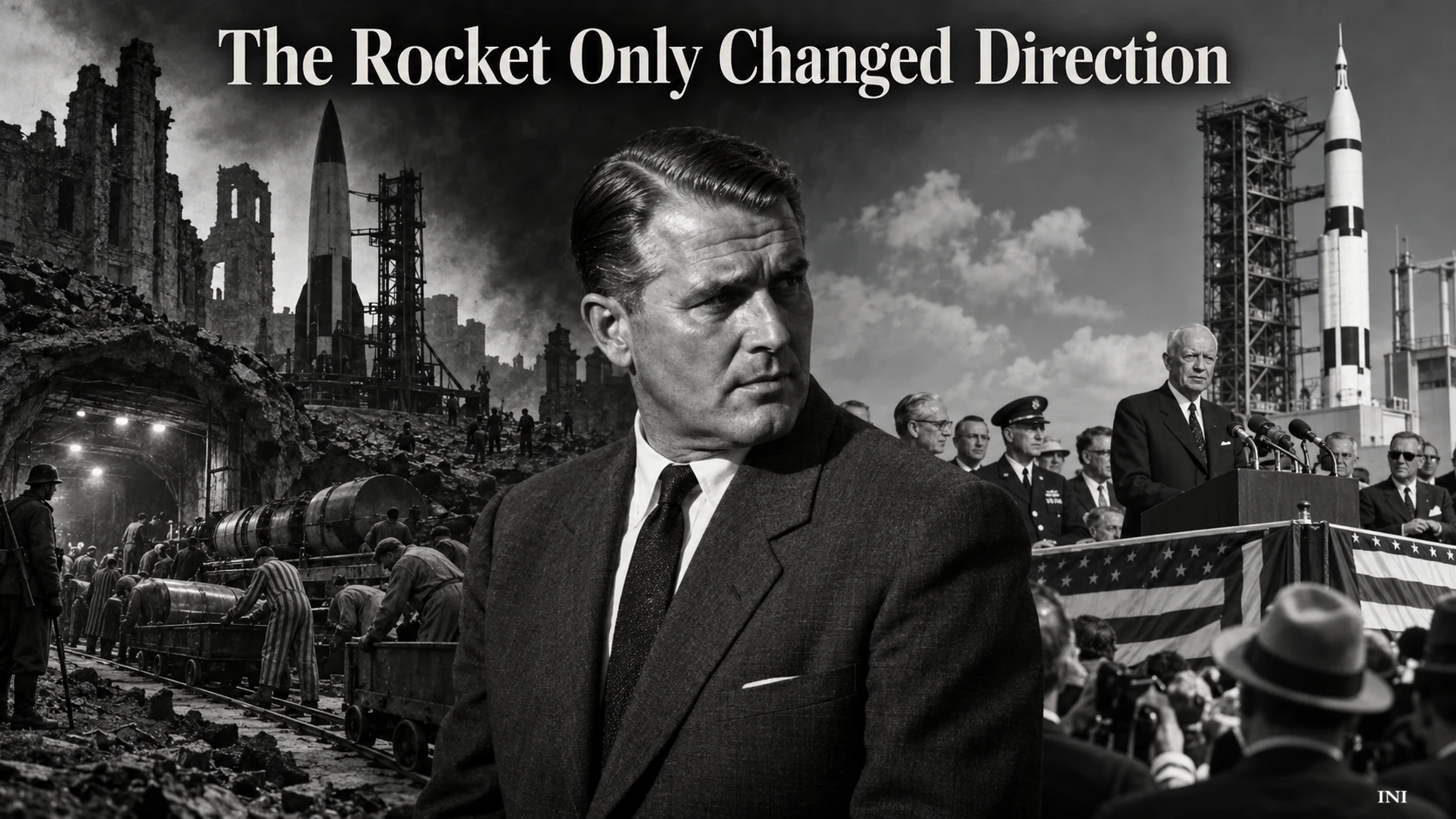
There are moments in history when civilisation suddenly begins taking morality very seriously.
Then it turns out that morality is, of course, important.
Just not quite as important as rocket science.
On September 8, 1944, the first V-2 to hit London came down in Chiswick. Three people were killed. The rocket was fast, advanced, technically astonishing, and, in human terms, precisely the kind of achievement that tends to interrupt any sentence about the magnificence of human intelligence with an explosion.
Exactly sixteen years later, on September 8, 1960, Dwight D. Eisenhower dedicated the Marshall Space Flight Center.
Its first director was Wernher von Braun.
Sometimes history does not write.
It merely underlines.
The same man. The same extraordinary technical ability. The same rocket science that had sent V-2s crashing down on European cities only a few years earlier was now being directed upward.
The flag had changed.
The technology had no trouble adapting.
We should resist the temptation to diminish Wernher von Braun’s genius. It would not only be historically false, but morally far too convenient. Life would be easier if he had merely been a mediocre engineer with a bad character. Then one could place him neatly in the appropriate drawer, label it “Nazi,” close it, and by evening once again feel satisfied with the orderly arrangement of one’s conscience.
But von Braun really was exceptional.
The V-2 was a technological breakthrough. The Saturn programme later helped produce one of humanity’s greatest engineering achievements. The Moon was not a public-relations trick. The Saturn V was not made of propaganda cardboard. Human beings genuinely reached the place at which they had spent thousands of years merely looking upward.
It is difficult to look at that rocket without feeling admiration.
It is equally difficult to look at it while knowing where the road to it began.
That discomfort is the point of the story.
Von Braun was a member of the Nazi Party. He became an SS officer. V-2 production relied on the forced labour of concentration-camp prisoners. People died in underground factories building weapons that would go on to kill others elsewhere.
The rocket had its dead at both ends.
Then came 1945, and among the ruins of Europe the great moral reckoning began.
Rightly so.
The world declared that there were crimes for which “those were the times” could no longer serve as a sufficient explanation. Judgments were handed down at Nuremberg. Civilisation attempted to redraw the line beyond which obedience was no longer an excuse, orders no longer absolution, and state interest no longer a moral magic spell.
But the victors did not find only camps, ruins, and documents in Germany.
They found engineers too.
The war had barely ended when the next era began recruiting among the wreckage. The Americans and the Soviets did not agree on much about the world, but they quickly discovered a shared belief that it would be a pity to judge a rocket engineer solely by his past.
Especially if he was a very good rocket engineer.
Von Braun and his colleagues, in this new situation, were not simply prisoners. Nor were they quite defendants. They became something closer to war booty that could speak, calculate, read blueprints, and, if required, design another weapon.
The victors first took home the German rockets.
Then they realised it might also be useful to take home the people who knew how to build new ones.
Because another question had suddenly become urgent:
Who knows how to build rockets?
In one building, the past was being put on trial.
In another, it was being interviewed for a job.
And this is where the story becomes truly uncomfortable.
The scandal is not, in itself, that after the war not everyone was simply written off as permanently unusable. A civilisation that believes in responsibility can, in principle, also believe in reckoning, remorse, and the possibility of a new beginning.
But a second chance usually requires something.
Reckoning. Acknowledgement. Remorse. The willingness to say what happened, to whom it happened, and at whose expense this new life is now supposed to begin.
Strategic utilisation does not necessarily require any of that.
Expertise may be enough. A security review. A few biographical paragraphs rewritten in more cooperative language.
One is a moral process.
The other is a personnel decision.
And few things can be made to align as elegantly as state interest and carefully edited memory.
Not everyone, after all, proved equally forgivable.
The era’s peculiar system of grace did not ask only how guilty a person had been.
It also asked how much he was still worth.
If someone possessed knowledge useful for the next war — for rockets, aircraft, intelligence operations or weapons programmes — their past suddenly became more complicated.
Nuance appeared.
Circumstances.
Professional value.
Strategic necessity.
Those who arrived without useful equations, blueprints, codes, or names often found that their biographies remained considerably simpler.
It was not necessarily the less guilty who were given a new life.
It was those whose knowledge still worked in the next era.
The first question was:
What do they know?
Only then came:
What did they do?
If the first answer was interesting enough, the second question usually became quieter.
This was not an American speciality.
It was a great-power instinct.
The Americans took their German specialists. The Soviets took theirs. Other countries also tried to acquire whatever could still be used from German science and technology. The victors differed in political system, ideology, and self-image, but they all spoke the language of usefulness with remarkable fluency.
A Nazi past could become an unfortunate biographical detail. SS membership could become a security issue to be managed in the proper office. Forced labour could become historical background. Blood could become something that did not necessarily require detailed mention in the ceremonial speech.
Technology changed direction.
Morality merely changed employers.
Power has a remarkable ability to regard the same person as a moral danger one year and a strategic asset the next, while maintaining a perfectly serious expression on both occasions.
And there is nothing particularly historical about that.
We still do it.
Only with better business cards.
The compromised intelligence officer becomes a valuable source. The dictator who yesterday appeared in a human-rights report becomes tomorrow an “indispensable regional partner” if he happens to possess the key to the right port, gas pipeline, or military base.
Even the vocabulary performs the same wonderful transformation.
Yesterday: unacceptable.
Today: problematic.
Tomorrow: to be handled pragmatically.
Next week: strategically important.
One of history’s most reliable signs that someone is about to be morally rehabilitated is the discovery that they possess something we need.
Oil.
Rare earths.
Intelligence.
Or simply a telephone number nobody else dares to call.
At that point morality does not disappear.
It merely becomes a negotiating position.
The modern world likes to believe that it has evolved beyond this. We have compliance systems. Codes of ethics. Sanctions lists. Due diligence. ESG reports. Corporate values in a carefully chosen typeface.
All of this is enormously reassuring.
Right up until something important is at risk.
Then principles suddenly meet the supply chain.
And the supply chain usually comes better prepared.
Morality rarely vanishes altogether. It tends to remain in the press release.
Where the decisions are actually made, however, morality has to make room for reality.
“Reality” is a wonderful word. Cold enough not to show the hypocrisy, serious enough to make cowardice sound responsible.
It usually appears when someone would like to say:
We know this is unpleasant, but we need him.
One simply cannot put it like that.
Instead, one says that we cannot afford the luxury of moral purity.
“Moral luxury” is an especially beautiful phrase.
It usually means that someone else will pay the price of the morality we have decided we cannot afford.
That is why Wernher von Braun’s story is not black and white.
Nor should it be.
We do not need to take away his genius in order to see his past. And we do not need to deny the greatness of the Moon programme in order to notice the underground tunnels as well.
Perhaps that is what mature memory would actually look like.
Looking up at the Saturn V.
Then looking down.
At the underground factory. The prisoner. The corpse. London.
And enduring the fact that all of it belongs to the same story.
In 1944, the rocket was terror.
In 1960, it was part of a dedication ceremony.
A few years later, that same expertise had a lunar programme, a budget, and a ceremonial emblem.
Because in history, not every past can be forgiven.
Only the ones that come with an instruction manual.
Comments
Loading comments…