
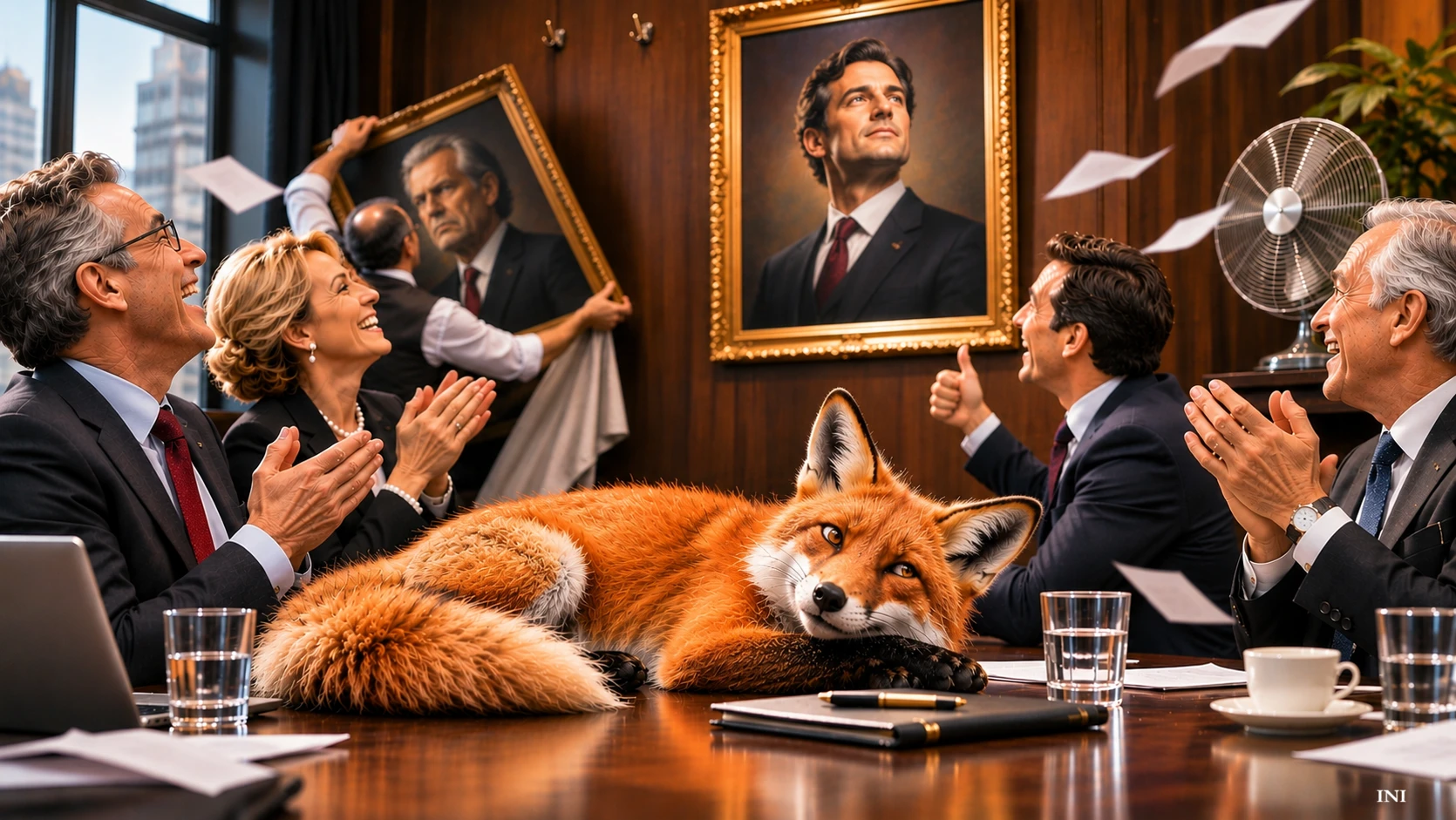
The fox has somehow never managed to earn itself a particularly good reputation.
Cunning, we call it. Calculating. Sly. Untrustworthy. Whenever a fox appears in a story, you can usually assume that somebody is about to come off badly, and that somebody is unlikely to be the fox.
For centuries, we watched it avoid danger, seize opportunities, and show remarkably little attachment to places where circumstances had become unfavourable.
We called it a moral failing.
Then we discovered much the same qualities in ourselves and became rather more careful with the vocabulary.
You can hardly write on your CV that throughout your career you have shown an exceptional instinct for moving closer to the new boss and having lunch with the old one a little less often.
So we invented adaptability, strategic thinking, political awareness, flexibility, and several other expressions that gave much the same instinct a better-cut suit.
The fox would probably have found all this rather unnecessary.
When it was hungry, it tried to get into the henhouse. It did not claim to be acting in the long-term interests of a sustainable poultry sector, nor did it issue a statement explaining that its previous position regarding chickens had evolved in light of changing circumstances.
It simply wanted dinner.
We are more advanced.
We prefer to arrange our interests so carefully that, eventually, they begin to resemble principles. If we tell the story properly, we may even end up believing it ourselves.
Some people cope remarkably well with every change of management.
Not the good professionals who simply carry on working while the organisational chart is redrawn.
I mean that particular type who, halfway through the new director’s opening sentence, discovers that they have believed precisely this all their lives.
Such people rarely lie in any obvious way.
They simply rearrange their memories.
On Monday, everyone knows that cost reduction is essential to the company’s survival. On Tuesday, the new director explains that we have spent too long thinking defensively and must now pursue bold growth. By Wednesday, several colleagues have always been concerned that excessive cost discipline might be holding back innovation.
On Monday, some of these colleagues had needed three slides to explain why innovation represented an unacceptable cost risk.
Fortunately, by Wednesday, the slides were obsolete.
Their authors were not.
They are not necessarily bad people.
The truly experienced organisational fox simply feels the draught sooner. It closes one window while everyone else is still debating whether the room has actually become colder.
Corporate life also provides the language.
You do not have to say that yesterday you thought something else. You can simply note that the environment is changing dynamically.
You do not have to admit that you backed the wrong horse. New priorities have emerged.
You do not have to say that the previous plan failed. The organisation has entered a new phase of its development.
If a fox finds a dog behind one bush, it moves to another. It does not first prepare a thirty-eight-slide presentation explaining that changing bushes has always been an integral part of its long-term woodland strategy.
We are not less opportunistic.
It simply matters to us that our opportunism comes with a narrative.
In politics, this has almost become an art form.
Young politicians occasionally make the mistake of speaking clearly. They say what they believe, which principles they will never compromise, and whom they would never consider sitting at the same table with.
Unfortunately, such statements have an inconvenient habit of surviving elections.
Especially now that everything is archived.
The more experienced politician therefore learns to handle eternity with greater care. They understand that “never” is an exceptionally long time, particularly during coalition negotiations.
And when an old statement does resurface, there is always an explanation.
The situation has changed.
The national interest requires a different approach.
Information is now available that was not available at the time.
Sometimes this is genuinely true.
Which makes the whole thing more uncomfortable, not less.
People are, of course, allowed to change their minds. In fact, it can be rather worrying when somebody has not done so once in twenty years. The world changes, we learn, we acquire new experience, and sometimes we simply discover that we were wrong.
The question is not whether our position changed.
The question is which changed first: our thinking or our interests.
From the outside, there is rarely a precise answer.
From the inside, rather more often.
We just do not usually hold press conferences in there.
This is why we are perhaps a little unfair to the fox. At least it is not troubled by the need to turn its movements into a story of moral continuity.
If it was there yesterday and somewhere else today, then it is simply somewhere else.
It has no need to prove that it was travelling in exactly the same direction all along and that the landscape merely rotated around it.
On social media, nobody ever seems to change jobs because another company offers more money or because they can no longer bear their boss.
Everyone is beginning a new chapter.
Moving towards new challenges.
Grateful for the journey so far.
Excited to bring their values to a new community.
There is nothing particularly wrong with any of this. It certainly sounds better than writing: “They are paying me twenty per cent more, and my immediate manager has gradually become a permanent part of my nervous system.”
If there is more food in the neighbouring wood, the fox goes there.
It does not call it personal growth.
After decades in business, I came to suspect that companies had mastered the art of changing their minds without admitting that anything had changed.
A product is not discontinued. The portfolio is rationalised.
A company does not withdraw from a market. Resources are reallocated.
People are not dismissed. The organisation becomes leaner.
And a bad strategy does not fail. A strategic cycle comes to an end.
Listen to this for long enough and you begin to suspect that companies almost never make mistakes.
They simply conclude a surprising number of strategic cycles earlier than originally planned.
You learn the language yourself eventually.
To some extent, you have to.
You cannot sit through every meeting like a guest at the wrong wedding, asking whether this is not the exact opposite of what everyone said last year.
In time, you learn that there is a polite corridor between yesterday’s truth and today’s truth.
Some people find that corridor remarkably quickly.
Their careers rarely suffer from it.
Opportunism, it turns out, is rarely judged by the behaviour itself. It is judged by the outcome.
A politician who abandons an alliance at precisely the right moment may become a pragmatic statesman. A week earlier, a traitor. A month later, there may be nobody left to betray.
Business follows much the same logic.
Choose the winning trend, and you are a visionary. Choose the losing one with precisely the same conviction, and you have fallen for the hype.
In hindsight, it is remarkably easy to distinguish courage from opportunism.
A stock-market chart can settle a surprising number of moral questions.
The fox may trouble us partly because it lacks the lion’s theatrical strength or the eagle’s solemn dignity.
It does not want to change the forest.
It is enough for it to notice, in time, that the forest is changing.
And a surprising number of people navigate human society successfully because they have mastered precisely this ability.
They know which opinion can still be expressed loudly for a while, which one is better reserved for private conversation, and which one will soon require the admission that they had always had certain reservations about it.
They are not necessarily cynical.
Cynicism would be exhausting.
It is much easier to change gradually with the surroundings until, one morning, you discover that you believe exactly what the new situation requires.
And this happens to all of us.
Not necessarily dramatically.
We adapt to family, work, country, age, fashion, power and money. We adapt to people we want something from — and adapt again when we no longer do.
Sometimes this is maturity.
Sometimes common sense.
Sometimes cowardice.
Occasionally all three in the same afternoon.
At least the fox never claimed to have principles.
We generally do.
Then time passes, the company changes, different people end up at the head of the table, and our old statements begin to feel awkwardly distant. We do not even have to deny them. We add a few circumstances, some experience, a little historical context, until it seems entirely natural that we think differently now.
Perhaps we really do.
At night, the fox goes back into the woods.
We go home, take off our coats, sit down, and sometimes — if the room is quiet enough — we can still remember what we thought before we checked which way the wind was blowing.
Comments
Loading comments…