“The rat’s greatest offence is that it does remarkably well in the world we have created.”
Illusions Not Included
The rat has never been particularly successful at getting good press.
It is not majestic like the lion, elegant like the horse, or inclined to gaze into the distance with the dignity of an eagle. Nor has it acquired the sort of place in human cultural memory that leads us to cast it in bronze and place it in the middle of a square.
The rat usually appears in our stories when something has already gone wrong. It turns up in cellars, among the ruins of war, in sewers, around docks and beside heaps of rubbish. Sunsets are rarely part of the scene.
And it is not only dirt and neglect that have attached themselves to its image, but disease and epidemics as well. For centuries it has been bound up with our fear of infection: that peculiarly human unease that begins when something invisible is spreading and nobody knows quite where it came from.
There is perhaps a certain injustice in this.
The rat did not build any of those places.
We dug the sewers. We allowed the cellars to become damp. We produce the rubbish, and in such quantities that for a moderately ambitious rat family the main question is often simply where to set up home nearby.
Yet the rat became the symbol of filth.
Rather as if someone spent the entire evening scattering dinner around the living room and then regarded the ants the following morning with moral outrage.
Civilisation has an old habit of first creating the conditions and then deeply resenting those capable of adapting to them.
The rat happens to be remarkably good at this.
It is not especially demanding, has no attachment to prestigious addresses and does not take offence when the neighbourhood declines. It does not write to the local council complaining that quality of life around the rubbish bins has deteriorated noticeably in recent months. It simply establishes whether the place is habitable and, if it is, generally sees no compelling reason to look elsewhere.
Human beings tend to regard the same quality in themselves with considerably greater respect.
We are adaptable, flexible and resilient. We can recognise new opportunities in changing circumstances, and we value this ability particularly highly when it eventually works in our favour.
If a company finds a new market after a crisis, that is innovation. If someone leaves a collapsing system in time, that is foresight. And if an entire society gradually learns to live with conditions it would have considered unacceptable only a few years earlier, sooner or later this becomes historical experience.
The rat does roughly the same thing, only with poorer communications.
It does not give lectures on resilience, write books about how it found itself in the sewer, or, as far as anyone can tell, make much use of the concept of growth outside one’s comfort zone. In the modern world this is undoubtedly a disadvantage, because survival by itself is rarely enough. It generally needs some sort of story.
The rat has no such story.
It has hunger, a reproductive instinct and a fairly consistent sense of where food is likely to be found after dark.
Human beings are considerably more advanced. We can transform similar impulses into institutional missions, economic strategies or personal value systems. If we want more, we are ambitious. If we acquire something before someone else does, we are competitive. If we leave a failing system in time, we have made a strategic decision, and if enough of us do the same thing at once, it becomes a social trend.
Compared with this, the rat is an awkwardly uncomplicated creature. It does not try to find a moral or philosophical justification for eating what it finds, nor does it appear to feel any need to translate its instincts into more elevated language.
Perhaps there is something in that, too, which we find difficult to forgive.
The relationship between humans and rats is ancient and, in a peculiar way, rather intimate.
Wherever human beings settled, the rat eventually appeared too: in docks, warehouses, ships, markets, cities, tunnels, metro systems and industrial sites.
It does not follow us out of affection. It follows us because human civilisation has developed an extraordinary ability to concentrate food, warmth and waste in the same places.
Seen through the eyes of a rat, a modern city is, in certain respects, an urban-planning miracle.
Millions of people live above and beside one another. Tonnes of food are brought in every day, a considerable portion is left uneaten, and then elaborate logistical systems collect what remains and move it to designated locations.
To support all this, we build underground passages, sewers, warm plant rooms and warehouses, while leaving behind gaps whose existence we generally discover only once something has begun using them.
The rat did not conquer the city. It simply moved into what we had prepared.
Perhaps that is why the sight of one can feel so oddly insulting. Not because it is alien, but because it moves with such obvious ease through what we have created.
Human beings like to think of themselves as bringing order to nature. We build walls and roads, install drainage, disinfect, regulate, package, label and remove. By day, the city is largely evidence of this order.
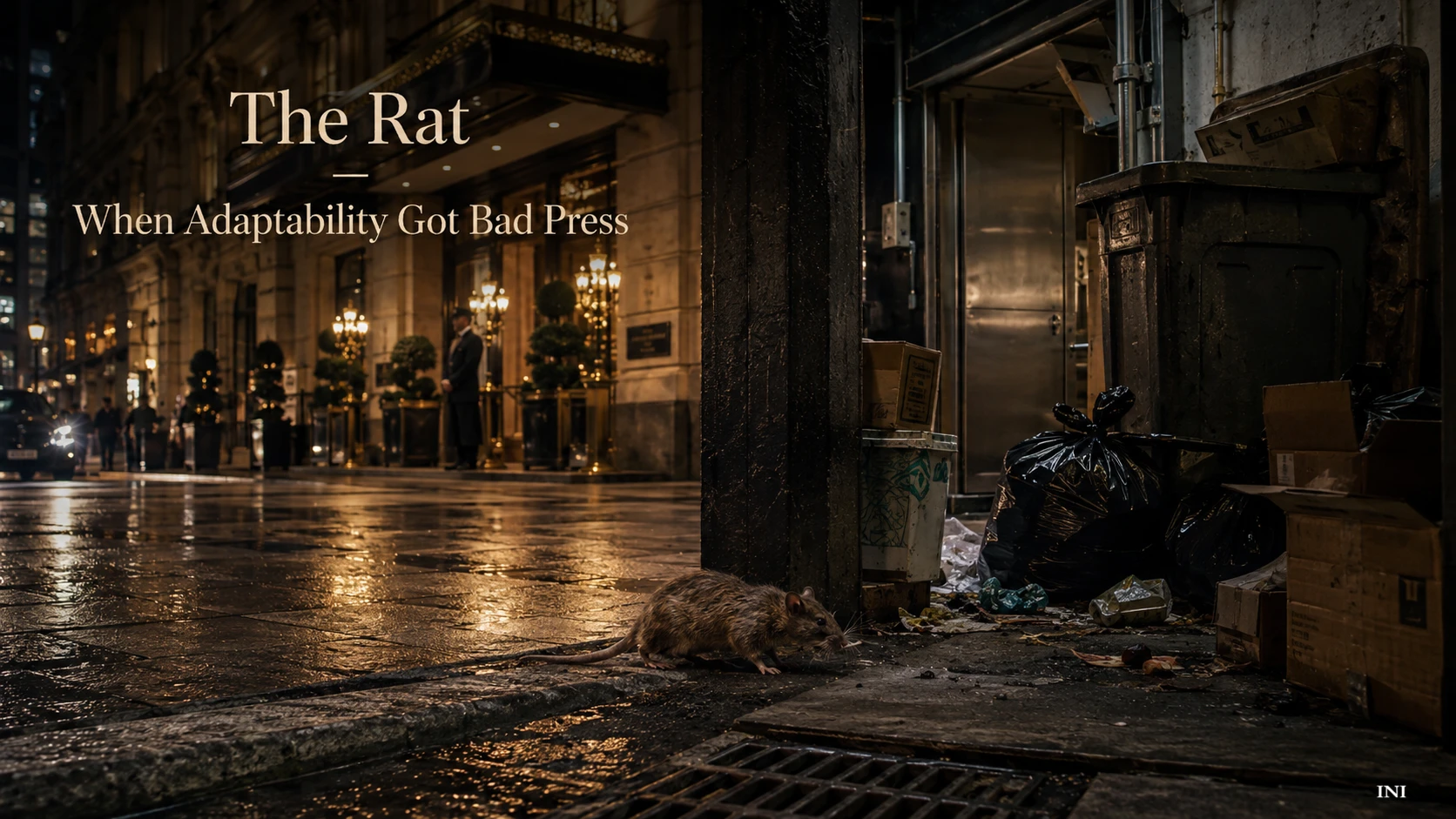
Then the restaurants close, the bins fill, a few streets grow quiet, and a rat runs across the pavement.
For a moment, a less presentable side of that order becomes visible.
Nature has not returned. It never really left. During daylight hours we simply managed to arrange the view so that it was less noticeable.
Perhaps that is also why we use the word rat so readily as an insult.
A traitor is a rat. An informer is a rat. So is someone who turns on others for personal advantage. Long ago, the word escaped from zoology and moved into morality.
It is an odd choice, because an actual rat rarely betrays an idea, a country, a friend or a political community. It has no secret bank accounts, does not send anonymous letters about colleagues to the board, and does not amend its testimony afterwards. For the most part, it is looking for food.
Yet human beings needed another species in order to name one of the less attractive forms of their own behaviour.
This is understandable in a way.
It is much more comfortable to call someone a rat than to admit that, under certain circumstances, they behaved remarkably like a human being.
We have also been talking about rats leaving sinking ships for a very long time.
Rats are supposedly the first to flee, and we rarely mention this as a compliment. Human morality somehow finds it nobler to go down faithfully with the institution than to notice early enough that the water is no longer exclusively outside the ship.
Organisations, in particular, place great value on the sort of loyalty that preferably lasts until there is no longer anything useful to be done.
Leave too early and you are suspect. Leave too late and you are unfortunate. The correct moment can usually be identified with great precision once everyone already knows what happened.
The rat philosophises less. If the place seems bad, it looks for another one.
Human beings, meanwhile, may still form a committee to determine whether the ship is actually sinking and, if so, what opportunities this creates for the new operating model. By the time the report is ready, the rat may already be close to shore, not because it is more heroic, but because institutional dignity means rather less to it.
Perhaps that, too, offends us.
Survival in itself is not especially noble. We prefer to give it moral content. Anyone who survives ought, ideally, to have a story to accompany it: courage, perseverance, values, sacrifice, decisions and, if possible, a few lessons.
The rat’s survival is unpleasantly practical. It stays as long as it can, moves on when it must, and eats what it finds. If a civilisation leaves enough waste behind, the rat does not feel obliged to interpret this as a personal insult.
Human beings are particularly uncomfortable with species that make too efficient a use of our by-products. There are too many pigeons in our squares, gulls come too close to our food, wild boar appear in the suburbs, and rats enter places where, according to us, they should not be. We talk about these animals as though they had violated the terms of some ancient agreement, although we wrote the agreement ourselves and can hardly blame them for failing to read it.
The rat is a particularly difficult partner in this respect because it has little respect for social status.
It does not care whether a building is a luxury hotel or a cheap warehouse. If it finds a gap, the price per square metre has little influence on its decision. Marble leaves it unmoved, it does not recognise VIP areas, and a Michelin star probably means little more than the likelihood of a kitchen somewhere nearby.
There is something uncomfortably democratic about this.
A considerable part of civilisation consists in creating distinctions.
Clean and dirty. Valuable and worthless. Prestigious and ordinary. Inside and outside. Those who can afford not to see the waste, and those who remove it at night.
The rat can connect them all in a single journey.
It can set off from the back door of an expensive restaurant, run beneath an elegant square, continue through a sewer and arrive by dawn at the place where the city stores everything it prefers not to see about itself during the day.
It does not understand the distinction between representation and reality.
We do.
Perhaps rather too well.
Modern cities devote enormous amounts of energy to keeping certain things invisible.
The rubbish should preferably not be in the street. The sewage should not be in the living room. Homelessness should not coincide with the tourist route. Poverty should not reduce property values. And the work that allows the city to look clean again in the morning should preferably be done by someone while everyone else is asleep.
One of civilisation’s important aesthetic achievements is that it usually manages to put the consequences somewhere else.
The rat, however, rather likes living where we put the consequences.
Perhaps that is why it always looks as though it is bringing us unpleasant news. In reality, its presence merely makes visible what we managed to push towards the edge of the picture during the day: that no clean system exists without a back door, no elegant form of consumption leaves nothing behind, and no order can be maintained without producing a certain amount of disorder somewhere else.
In this sense, the rat is not the opposite of civilisation.
It is one of civilisation’s recurring companions, appearing wherever the order we create meets the residue that order leaves behind.
And of course we try to exterminate it.
With traps, poison, walls, disinfection and every other means developed by a species that is quite reasonably proud of its technological sophistication.
The rat, in time, learns where the trap is. It adapts even to our attempts to remove it, something we describe as resistance, infection risk or a pest problem. When we do something similar after an economic crisis, a war or a social collapse, we generally choose somewhat more elevated language, and occasionally build a monument to it.
The rat asks for none of this.
It requires no rehabilitation, does not expect justice from cultural history and is probably not especially troubled by what we think of it. From a human point of view, this may be one of its more unusual qualities.
We, meanwhile, devote ever more energy to showing one another who we are, what we represent, which values we hold, what we consume, what we believe and which side we are on in the argument that did not exist yesterday.
The rat understands very little of this.
It does not position itself socially; it simply looks for a place where it has some chance of staying alive, preferably somewhere close to food. This may not be especially noble, but at least it is clear.
And the next time a rat runs across a city pavement at night, we will probably watch it disappear with the same instinctive disgust as before.
It will vanish through a gap, while we continue along the clean, illuminated street above the closed restaurants, full bins, underground sewers and everything else we managed to hide from ourselves during the day.
The rat will carry on down there.
Not to judge us, and not to hold us to account.
It simply uses the world it found.
And perhaps that is precisely why it is so difficult to like.
Because sometimes it bears the marks of the world it found rather too clearly.