
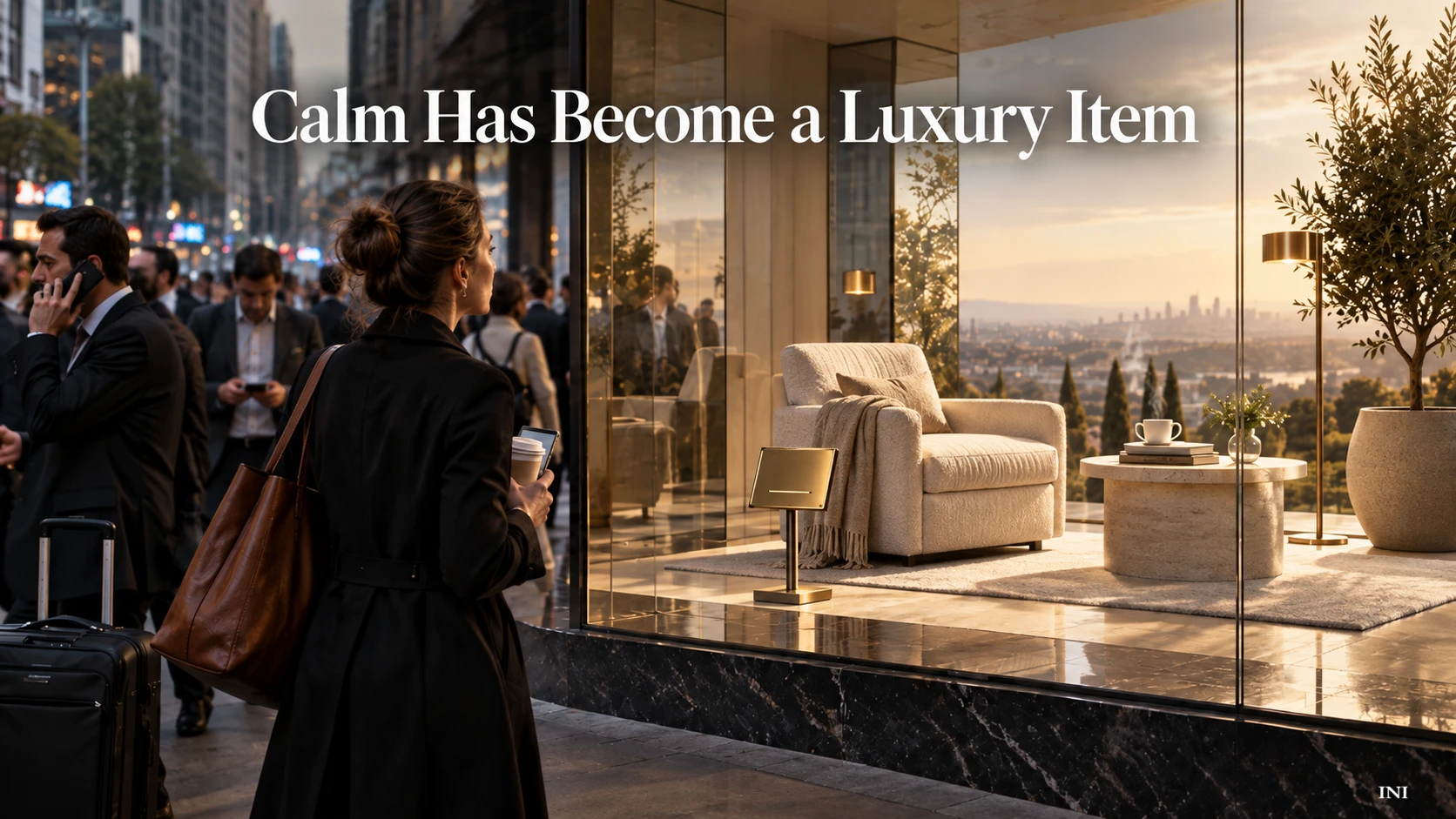
“Calm has become a luxury item. Discounts are rare.”
There was a time when silence did not require a booking.
You did not need a cabin in the woods, a soundproof hotel room, a private garden, or an estate agent promising that the flat was “quiet, yet close to everything”. That last phrase remains one of the more elegant promises of modern urban life: everything should be five minutes away, yet preferably none of it should be heard.
Silence was simply what remained when, for a while, nothing happened.
I would not want to romanticise the past. Neighbours drilled, dogs barked, and families could still find you whenever they urgently needed to, long before the invention of the smartphone. But noise still had some natural boundaries. The factory generally made its noise at the factory, the telephone hung on the wall, and the office — at least in theory — stayed where you had found it that morning.
Today the office is rather more adaptable: it comes home with us.
It travels with us in our pockets, cars and laptops. It accompanies us to the airport, to dinner and sometimes even on a weekend that was meant to take us away from everything.
“Everything” usually finds us within twenty minutes of arrival.
Meanwhile, calm has followed an interesting social trajectory. It was once hardly a status symbol. Under certain circumstances, it now comes remarkably close to being one.
A quiet flat costs more. A garden costs more. A separate study costs more. A house at the edge of a forest costs considerably more. With a terrace overlooking the sea, tranquillity is generally included in the price, although the sound of the waves naturally comes with its own marketing value.
At a hotel, we can request a room away from the lift. At an airport, we can pay for lounge access so that we can experience exactly the same flight delay in a more comfortable chair and a quieter environment. More and more trains have quiet carriages where phone calls are politely discouraged, which is an elegant example of how behaviour once regarded as ordinary courtesy can eventually become a separate service category.
It is, in its way, an impressive business model.
First we fill life with noise. Then we offer its absence as a premium product.
I do not say this reproachfully. I too am quite willing to pay for a hotel room in which I cannot hear the neighbour forming opinions about the minibar pricing at two in the morning. My requirements of civilisation are fairly modest, and thick walls rank surprisingly high among them.
Still, it has gradually occurred to me that calm is becoming less a state of mind than a question of access.
It does not cost everyone the same amount to disappear for a while.
Some people can switch off their phone in the evening because whatever happens can be dealt with tomorrow morning. For others, failing to answer may mean less work the next day. Some can avoid the news for three days and suffer no worse consequence than feeling slightly uninformed. Others have to keep an eye on three different apps because that is where the shift schedule, the school, the doctor, the courier, the bank and, every now and then, life itself choose to communicate.
“Tomorrow” is not an entirely democratic institution.
For a long time, we imagined luxury meant being able to afford many things. Increasingly, it seems that luxury can mean the opposite: being able to afford not to do something.
Not to be available. Not to reply immediately. Not to know what has happened in the past twenty minutes. In particularly favourable circumstances, perhaps even to have somebody else know it for you.
Most of us, however, do not live with this constant sense of urgency because so many extraordinary things are genuinely happening to us. It is more that almost everything now arrives packaged as though it deserves our immediate attention.
The news is breaking. The offer ends soon. The email is important. The apps display red numbers. Someone has reacted to something another person said about a third, and the platform politely informs us of all this as though worried that, for several minutes, we might forget our central importance to world affairs.
The news itself has developed an interesting relationship with time.
Once, something happened and we read about it in the newspaper the following day. By then there was at least some chance that somebody knew what had actually happened.
Now an event first appears as breaking news, followed by the first update, the first reaction, the first analysis and, a few hours later, the first analysis explaining why the first analysis was wrong. By the time a reasonably coherent picture has emerged, another story has usually taken over the screen, while the opinions generated by the previous one continue circulating quite efficiently.
There is nothing especially tragic about this. Humanity has always enjoyed knowing what was happening next door. The neighbourhood has simply become rather large.
The more difficult change is that information now seems to come with a mild obligation to participate.
It is not enough to know that something has happened. One should also have a view on it. Preferably quickly, because within a few days everyone will be concerned with something else.
Sometimes I feel that the sentence I don’t have an opinion on that yet is slowly entering the same category as the handwritten letter. Still technically available, but faintly old-fashioned.
I am no exception.
If nothing happens for a few minutes, sooner or later I check my phone to make sure that nothing really has happened. The gesture has become so natural that I often notice it only afterwards. There was no notification. I was not expecting a message. There was no particular reason to look.
I had simply checked the state of the world, which had continued functioning reasonably well without my supervision.
The phone itself bears surprisingly little responsibility. Most of the time it lies quietly on the table, displaying considerably more calm than its owner. It makes no demands, takes no offence if ignored and cannot even manage a reproachful expression.
It does not need to.
By now, we know what to do.
Each interruption is, of course, insignificant. A few seconds. A message. A short reply. A glance at the news. None of them seems serious enough to justify any real defence.
Calm is rarely taken away by one great noise. More often it disappears through a large number of small, perfectly reasonable intrusions. By the time they have accumulated, surprisingly little of the day remains to which somebody else does not have at least theoretical access.
And naturally, the market has produced an answer to this as well.
An entire industry now exists to give us back, for a few days, what another industry has successfully taken from us during the rest of the week. Retreats, quiet hotels and cabins in the woods offer several days during which we do not have to remain permanently available. The package usually includes nature, breakfast and a certain amount of time to which nobody else has access.
At the more expensive end, there may even be no mobile reception — something that, not very long ago, we would probably have reported as a technical fault.
Perhaps that is what we are really paying for.
I see nothing wrong with it. I would happily spend several days on a hillside at a suitable distance from the nearest conference call. If the coffee is good, I am even prepared to tolerate a complete absence of spiritual growth.
What interests me is how we got here.
Something that was once a natural part of everyday life has gradually become a special occasion. We travel somewhere for silence, book time alone, and announce our unavailability in advance. It is not as though anyone has forbidden us from simply being left alone. It is merely that what once required little more than a closed door has now become a service category.
Perhaps the more interesting question, then, is not how to obtain more calm, but how we arrived at the point where its absence feels so normal.
There was no dramatic turning point. Nobody announced that from now on we would receive a smaller daily allocation of silence. More and more small things simply found their way into our lives, each asking for only a few minutes. And because none of them seemed like very much on its own, we generally made room.
That is how calm gradually became a luxury item. Not because somebody began selling it at an outrageous price, but because more and more of us have to make a deliberate effort simply to experience it.
Once, closing a door was often enough. Today we announce our unavailability with an out-of-office reply. We are still entitled to some peace and quiet. It is simply considered polite to notify everyone first.
Comments
Loading comments…