
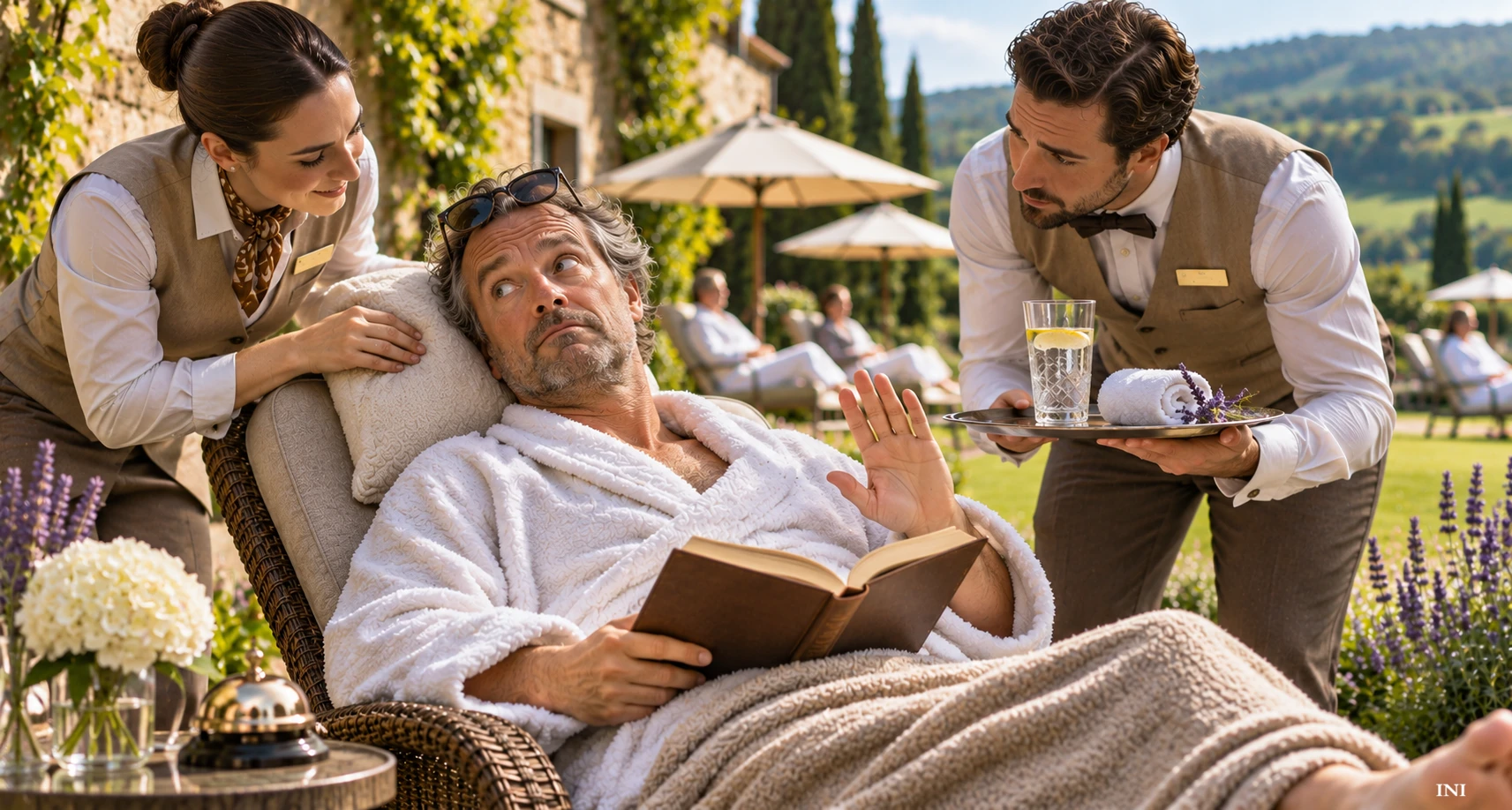
The most reassuring thing about expensive relaxation is the receipt. It proves that the afternoon was not wasted. Money was spent, a service was provided, and something of value must therefore have taken place.
This is a considerable improvement on the old arrangement, under which a person could spend several hours doing nothing and have absolutely nothing to show for it.
The modern world has found a solution.
Calm is now available in carefully selected surroundings, with suitable lighting, soothing music and a programme designed by people who have studied the subject professionally. There are different packages, naturally. Not everyone requires the same degree of tranquillity, and it would be unreasonable to expect those who pay more to receive merely the same silence as everybody else.
A typical programme may include an introductory consultation, guided stillness, a period of personal reflection and a closing conversation about the experience.
There may also be refreshments.
The actual resting takes place somewhere between these activities, provided the schedule allows.
I have nothing against pleasant hotels or comfortable armchairs overlooking the sea. There are worse ways to spend money, and I have occasionally spent it on considerably less agreeable experiences. What interests me is how an ordinary human need has become a specialised service, complete with expert supervision and, occasionally, proof of satisfactory completion.
We no longer simply take time off. We invest in recovery. A quiet afternoon becomes a restorative experience. A holiday is an opportunity for personal renewal, preferably one that can be described convincingly upon our return.
The vocabulary matters. Nobody wants to admit to spending three days doing nothing when they could have been participating in a carefully curated programme of wellbeing.
The second description sounds considerably more responsible.
It also looks better on an invoice.
There was a time when leisure did not have to compete for our approval. People occasionally did things simply because they enjoyed them. An afternoon in the garden, a book that taught nothing useful, a conversation that led nowhere.
Such activities have become increasingly difficult to defend.
If we read, we should learn something. If we walk, we should improve our health. If we travel, we should broaden our horizons. Even a pleasant evening with friends ought, ideally, to enrich our lives.
Enjoyment alone seems a rather modest return on the time invested.
Hobbies are particularly vulnerable. Someone who enjoys painting will eventually be encouraged to sell their work. A person who cooks well is advised to start a food channel. A man who spends his weekends restoring old furniture may discover that he has, without being consulted, acquired the foundations of a promising small business.
His friends congratulate him.
He had only wanted to repair a chair.
Apparently, one of the greatest dangers facing modern humanity is that an enjoyable activity might remain entirely unproductive.
Nothing should be wasted.
Least of all pleasure.
I must admit, I am not entirely immune myself.
When I sit down with a book in the afternoon, I sometimes catch myself checking how many pages I have read. If the number is disappointingly small, I feel faintly dissatisfied. Yet the book is not going anywhere, and the author is hardly expecting proof of satisfactory progress by evening.
Still, it is reassuring to know that I have made some progress.
Through the story, naturally. Though the page count is reassuring too.
Fortunately, nobody else knows about it.
That at least saves me the trouble of preparing a report.
The commercial world has understood this weakness rather well. We do not merely wish to feel better. We wish to feel that we have done something worthwhile in order to feel better.
An expensive retreat is particularly useful in this respect.
Guests arrive with considerable expectations. They are welcomed, informed about the facilities and introduced to an itinerary designed to make their stay as restorative as possible.
The programme has been carefully planned. There are appropriate periods for activity, reflection and relaxation. Those who wish to do nothing at all are strongly advised to consult the programme first.
An hour of uninterrupted quiet may require advance booking.
The guests follow the arrangements conscientiously. After all, they have paid for the experience, and it would be irresponsible not to take full advantage of it.
At the end of their stay, they are invited to describe how much they have benefited.
Nobody wants to spend a considerable sum on personal renewal only to discover that they have returned fundamentally unchanged.
Fortunately, the benefits are often described in sufficiently broad terms to accommodate a wide range of outcomes. A person may feel calmer, more balanced, more connected with themselves or simply better prepared for the challenges ahead.
There is always something to take home.
Along with the bill.
The business model is rather elegant. It sells not merely comfort but permission. The customer is reassured that the hours spent doing nothing were neither idle nor selfish. They formed part of a considered investment in personal wellbeing.
The price is higher.
The conscience is clearer.
We are not being lazy.
We are investing in ourselves.
The workplace, naturally, has recognised the advantages of this approach.
Every respectable company now acknowledges the importance of employee wellbeing. The subject appears in annual reports, recruitment materials and photographs of smiling colleagues in surroundings where nobody seems to be answering emails.
A particularly conscientious manager sends a message to his team on Sunday evening.
“Don't forget to look after yourselves! Your health always comes first.”
Below this, he adds a few questions about Monday's presentation.
He emphasises that, naturally, no reply is expected before the morning.
Within ten minutes, three people have answered.
Their commitment is exemplary. More importantly, it is visible.
The manager acknowledges their replies with a thumbs-up. Nobody has technically violated the company's work-life balance policy. Everyone has merely demonstrated an exceptional sense of responsibility.
The company may also offer discounted access to a wellness programme.
This is undoubtedly generous. Employees can now purchase a little relief from the pressures of their working lives at a price negotiated on their behalf by the organisation responsible for a considerable proportion of those pressures.
Consultants are available to explain how exhaustion should be managed. Reducing its causes may require a separate budget.
It would be unfair, however, to pretend that everyone has the same opportunity to purchase tranquillity.
For someone working two jobs, caring for a sick relative or worrying about the next bill, rest may genuinely be a luxury. Not because it requires expensive equipment, but because it requires time and a degree of security that cannot simply be summoned through positive thinking.
Telling an exhausted person to pay more attention to their wellbeing is excellent advice. It becomes somewhat less useful when the person must choose between taking a break and paying the rent.
Personal responsibility is particularly popular in such circumstances. People are advised to become more resilient and set better boundaries.
The conditions that exhaust them, meanwhile, are under no obligation to change.
Naturally, there is nothing inherently absurd about paying for comfort. I have done so myself, and generally found the comfort agreeable. I was also rather pleased with myself for having made such a responsible investment.
A comfortable chair is pleasant enough. A comfortable chair that contributes to one's personal development is much easier to justify.
Even leisure has acquired a business vocabulary.
We allocate time to ourselves. We manage our personal resources. We optimise our routines and make strategic decisions about our wellbeing.
I have occasionally used such expressions myself. They sound more respectable than admitting that I spent an afternoon doing precisely what I wanted, which happened to be very little.
The language has a reassuring quality. It suggests purpose, discipline and a commendable concern for the future.
The activity itself remains unchanged.
Only the presentation has improved.
I sometimes wonder whether we have become so accustomed to earning things that we no longer quite know what to do with something that does not have to be earned.
A quiet afternoon makes no demands. It offers no certificate, no measurable improvement and no particular justification for its existence.
One might think this would make it attractive.
Instead, we search for a purpose.
Perhaps the afternoon will improve our concentration. Perhaps it will restore our creativity or prepare us for another demanding week. Perhaps, if we approach it correctly, we shall emerge as slightly better versions of ourselves.
The prospect is reassuring.
It would be a pity to spend several pleasant hours merely being alive.
There is something faintly sad about this. Not tragically sad, naturally. Nobody has abolished the afternoon, and sitting beneath a tree does not yet require official permission.
Though I suspect that, given sufficient commercial interest, someone will eventually offer a professionally supervised version.
The relaxation industry is flourishing.
Its customers remain tired.
Not long ago, I decided to spend an entire afternoon without accomplishing anything particularly useful.
I made no list and set no targets. I simply allowed a few hours to pass without turning them into a valuable experience.
It was surprisingly pleasant.
I read a little, sat quietly and allowed myself the unfamiliar luxury of having no particular ambition for the next few hours.
No appointment required my attendance. No one expected an opinion, a decision or a completed task. I gradually stopped looking for something that needed to be done.
Towards evening, however, I caught myself wondering whether I had used the time wisely.
For a moment, I even considered writing down what I had learned from the experience.
Then I realised that doing so would rather defeat the purpose.
For once, I left the afternoon alone.
Nothing important happened. Nobody congratulated me. I acquired no new skills and emerged with nothing that could reasonably be described as an achievement.
The world had managed remarkably well without me.
I found that harder to bear than Monday mornings.
In the end, I sat down and wrote about it.
After all, it would be a shame to let an entirely unproductive afternoon go to waste.
Comments
Loading comments…