
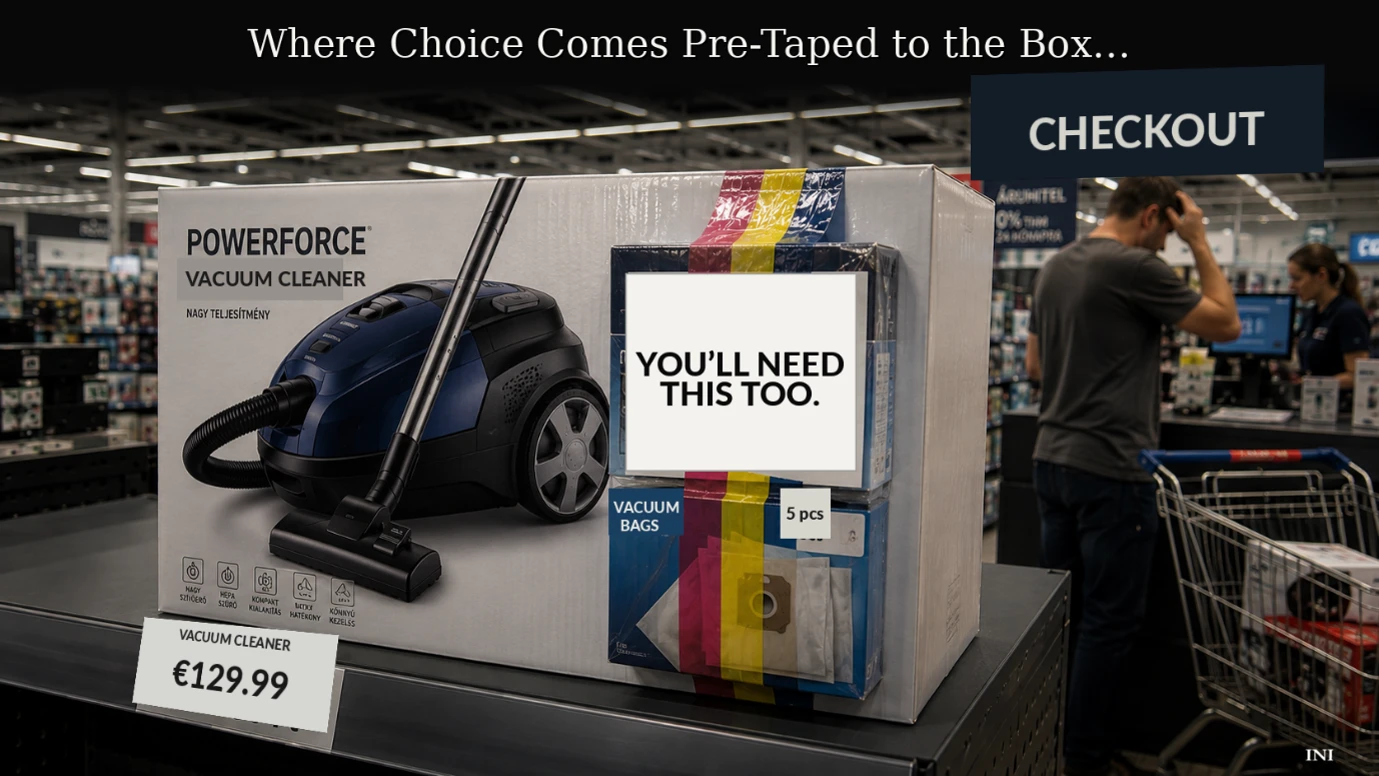
“Modern consumers are free to choose: accept what has already been chosen for them, or begin the paperwork.”
— Illusions Not Included
I was standing in a large electronics store.
I will not name it. Not because I am afraid to, but because it hardly matters. The method stopped belonging to any one company a long time ago. It is now part of retail culture. A small, self-adhesive footnote to the age.
It was Sunday, it was hot, and I wanted to buy a vacuum cleaner.
People rarely set out on a sweltering Sunday afternoon to buy a vacuum cleaner because they have suddenly developed a special interest in domestic appliances. Buying a vacuum cleaner is not usually an act of personal fulfilment. It is more often an admission that the old one has finally given up, or has begun making noises that turn cleaning the flat into a minor aviation event.
I looked through the selection.
There were cordless models, bagless models, intelligent models, quiet models, pet-friendly models, models designed for allergy sufferers, and at least one which, judging by the box, would not only clean the floor but improve family communication and reduce the household’s carbon footprint while doing so.
Eventually, I chose a conventional model.
The price label was there on the shelf. The product name, model number and price were clearly displayed. The situation appeared reassuringly simple.
One vacuum cleaner, one price, and one customer still carrying certain naïve assumptions from an earlier age, when the price shown on the shelf more or less indicated how much one would be expected to pay.
I lifted the box down.
Attached to the vacuum cleaner box, however, was a second, smaller box. It contained vacuum cleaner bags. A label on it said:
You’ll need this too.
It did not say that I might need it.
It did not say “recommended accessory”.
It did not explain that suitable vacuum bags were available elsewhere in the store in several varieties and price categories.
The sentence was far more confident than that.
You’ll need this too.
And, taken on its own, it was perfectly true.
I knew that this particular vacuum cleaner required bags. This was not my first encounter with a household appliance, and I had not assumed that the machine would eventually process the collected dust through spiritual means.
Vacuum bags run out.
Eventually, you have to buy more.
I had no argument with that.
Vacuum bags, however, like almost everything else today, come with a choice. There are cheaper ones, more expensive ones, originals, compatible versions, small packs, large packs, economy options and premium options. Before long, no doubt, there will be carbon-neutral, consciously biodegradable and individually personalised bags that not only collect dust but provide regular feedback on the emotional wellbeing of the household.
The pack attached to my vacuum cleaner belonged closer to the other end of the price range.
I did not know this while standing by the shelf.
The entire arrangement suggested some kind of promotion. The box of bags was not displayed separately beside the vacuum cleaner. I had not taken it from another shelf. I had not been invited to compare brands, pack sizes or prices.
They were already together.
They looked like a single offer.
Nor did the small label say:
“This appliance requires vacuum bags. Please choose from our available range.”
It said:
You’ll need this too.
And perhaps that was exactly why it worked so well.
Deception rarely begins with a completely false statement. That would be too crude. It is much more elegant when every individual detail is technically true, but their combined effect leads the customer towards a conclusion that nobody ever explicitly stated.
The vacuum bags are indeed necessary. The pack is indeed there. The price of the vacuum cleaner is indeed displayed.
What is not made sufficiently clear is that what looks like a single promotional package will become two separate items at the checkout.
Retail does not lie here.
It simply arranges the misunderstanding with care.
I gave it no further thought. The smaller box had been physically attached to the appliance, so I assumed it was part of the package. A starter set, perhaps. A promotion. A complimentary extra. Some surviving trace of that earlier commercial culture in which customers occasionally received something without a separate business model first being built around their inattention.
At the checkout, I was given a higher total.
I pointed out that a different price had been displayed on the shelf.
The cashier looked at the box, then at the screen, and said:
“The vacuum bags are not included in the price of the vacuum cleaner.”
This surprised me.
Not because I believed that I would never again need to buy vacuum bags. It surprised me because every visual and physical feature of the package on the shelf had suggested that what I was picking up was one offer.
In retail, packaging is also a sentence.
And adhesive tape can sometimes serve as the small print.
When two products are to be sold separately, one might reasonably expect them to be displayed separately. With separate prices, separate choices and perhaps even the possibility for the customer to decide which of the available vacuum bags to buy.
Here, however, the decision had already been prepared.
They had not merely placed some vacuum bags beside the machine. They had attached one particular, relatively expensive pack to it. The wider selection existed somewhere in the store.
But on my box, the decision had already been made on my behalf.
“If you don’t want them, we can remove them,” the cashier added.
And there it was: the essence of modern consumer freedom.
I was under no obligation to buy them. Nobody was forcing me. I could purchase the pack already attached to the vacuum cleaner, or I could stop the transaction, have it removed, return to the accessories section, find the correct type, compare the prices and queue again.
One option took a few seconds.
The other contained the rest of Sunday afternoon.
The choice therefore remained intact. It was simply that one decision was ready, packaged and taped to the product, while the other required a modest administrative procedure.
It was Sunday.
It was hot.
I was tired.
I paid.
Not because I had suddenly concluded that the more expensive vacuum bags would make me a better person. Not because, after careful comparison, I had selected them from the range. I simply did not want to stand there any longer. I did not want to explain, wait, move aside, return to the shelves and look for another pack.
I did not really buy the vacuum bags.
I bought the opportunity for the shopping trip to end.
And this is where the story becomes interesting.
Modern retail no longer merely assesses what we need. It also assesses how tired we are of having to choose.
A customer’s resistance is a finite resource. There comes a point when paying extra feels cheaper than the time, attention and nervous energy required to say no.
The store would not describe this point so directly, of course. Business language is more discreet.
It may be called increasing basket size.
Or cross-selling.
Perhaps a personalised customer solution.
The principle is simple: there is no need to persuade someone that the selected accessory is the best choice. It is enough to position it so that choosing something else requires more effort than simply paying for it.
Persuasion would require conversation. Arguments. An explanation of the benefits. Someone would have to say why this particular vacuum bag was better than another. They might even have to tolerate the possibility that the customer would choose the cheaper one.
Adhesive tape is far more efficient. It does not argue or persuade. It simply joins the product to the decision in advance, then politely allows the customer to separate them on their own initiative.
The vacuum bag itself is not especially interesting. I genuinely will need it. It will run out, and eventually I shall have to buy another pack. The problem is not the vacuum bag.
The problem begins with the sentence:
You’ll need this too.
It is one of the loveliest phrases in modern sales.
It sounds caring and decisive at the same time. It gives the impression that the store is helping us prepare for the future, while merely increasing the present bill by a modest amount.
It does not say:
“We would also like to sell you this particular, more expensive accessory.”
That would be unnecessarily blunt.
It says:
“You will need it.”
Commercial intent is thus transformed into customer need.
The company does not offer.
It decides what we need.
If this method continues to develop, products will soon cease to appear on shelves alone. Each will arrive accompanied by its likely consequences and the additional products preselected to deal with them.
A smoke detector will be taped to every toaster. Not because the appliance is unsafe, but because the retailer takes a responsible view of the complete consumer life cycle.
A blood-pressure monitor and a discount voucher for a private cardiologist will be attached to the coffee machine.
A packet of herbal sleep tea will come with every smartwatch, because from that moment onwards it will no longer be enough merely to sleep badly. We shall also need precise graphs showing exactly how badly.
A box of chocolates will be attached to the bathroom scales, so that the results can be processed in an emotionally appropriate manner.
A conventional handheld vacuum cleaner will be attached to every robot vacuum, so that the robot vacuum itself can be cleaned. The handheld vacuum will, naturally, come with bags.
Preferably not the cheapest ones.
You’ll need this too.
Eventually the system may extend into other areas of life.
When buying a car, the insurance, winter tyres, a premium parking-app subscription and the business card of a psychologist for processing the first service bill will already be attached to the vehicle.
When buying a home, the front door will come with mortgage protection insurance, a dehumidifier and a book explaining how to preserve one’s emotional balance during thirty years of debt.
A divorce lawyer’s card will be attached to every wedding dress.
And every coffin will come with life insurance.
A little late, perhaps, but on exceptionally favourable terms.
Not out of malice.
Out of foresight.
Modern commerce does not allow us to encounter the consequences of our own decisions unprepared. It packages them in advance, selects the appropriate price category on our behalf and, wherever possible, places everything on the same bill.
Every product gradually becomes a complete life situation. The coffee machine turns into a caffeine-consumption ecosystem. The smartphone becomes a continuous power-supply and data-security environment. The vacuum cleaner becomes a comprehensive domestic dust-management solution.
A product is no longer allowed to remain just a product. Business language has to enlarge it until the description catches up with the price.
Terminology matters.
“We attached a more expensive accessory in the hope that the customer would mistake it for a promotion and would not feel like going back to find a cheaper one at the checkout” does not look particularly elegant in a management presentation.
“Proactive fulfilment of customer needs” is much better.
The method also appears entirely fair. The prices are presumably displayed somewhere. The products can be separated. The customer can say no. The freedom to choose therefore remains formally intact.
It is simply that the choices do not stand on equal ground.
One passes through the checkout automatically. The other requires the process to be interrupted.
This may seem like a small distinction, yet a significant part of modern selling is built upon it. People do not always choose what they want more. They often choose what requires less resistance.
This is how preselected options, automatically renewing subscriptions and insurance policies that must be cancelled separately work as well. Consumer freedom remains present throughout; it simply comes with an increasing amount of administration. One may unsubscribe from the newsletter at any time, provided one can find the pale-grey lettering against the white background.
Perhaps one day refusal itself will incur a separate charge. It may be called an accessory-removal service or a personalised purchasing-configuration fee. Premium customers will have access to the “Only What I Chose” package, under which the store agrees to sell them only the product whose price was displayed on the shelf.
This will, naturally, be a higher level of service.
Simplicity is a luxury now.
I took the vacuum cleaner home.
Together with the bags.
At home, I looked at them and tried to decide whether I had made a good purchase after all. Possibly I had. I would need them. They would eventually run out. Perhaps I would even be glad that I already had them.
This is the final, particularly elegant part of the method. The customer begins explaining why the specific product they did not actually choose was, in fact, a good choice. Otherwise, they would have to admit that it was not the quality of the vacuum bags that persuaded them, but the heat, the Sunday afternoon and the desire to go home.
Along with the accessory, modern selling generally provides the necessary self-justification.
That, at least, comes automatically.
The vacuum cleaner has been working perfectly well. The bags are in the cupboard. I threw away the small label, although perhaps that was the one part I should have kept.
It was, after all, the most honest element of the entire package.
It did not tell me what I wanted.
It told me what I needed.
The choice had not disappeared. It was still somewhere among the shelves, available in several brands and at several prices.
But by the time I discovered that I was supposed to choose, one of the options had already been taped to the box.
And somewhere in a business plan, this is almost certainly called:
enhancing the customer experience.
Comments
Loading comments…