
“Thousands have lived without love, not one without water.”
— W. H. Auden
I was sitting in a café in Budapest.
I will not name the place. Not because I am afraid, but because it hardly matters. This is no longer about one particular café. It is a small sign of the times. A damp little footnote to an age that has learned how to monetise even the most basic human needs.
The bill was already ambitious enough. Cake, coffee, a few small things — and that familiar urban price level where one almost expects to find a separate line at the bottom:
“existential table-use surcharge — 890 HUF.”
At the end, I asked for only one thing.
— Excuse me, could I have a large glass of tap water, please?
The waitress smiled.
Politely. Tiredly. With the kind of smile people wear when they know that what is coming next is not an order, but a minor philosophical dispute.
— We have filtered water.
— Thank you, but tap water is perfectly fine.
A short pause.
— But this is filtered water.
At that point I could already feel that we were no longer talking about water.
We were talking about civilisation.
— I understand. But I would just like ordinary tap water. A large glass.
She looked at me with a slight embarrassment. It was clear she was not the villain of the story. She was only the first line of defence in a system that had placed her there, smiling between the customer and the business model. Behind her smile stood the owner, behind the owner stood the strategy, and behind the strategy stood the entire twenty-first century, which has perfected the art of giving us the same thing back under a new name — at a higher price.
Finally, almost under her breath, she added:
— We were told to recommend the filtered water. Actually, there isn’t really another option. If people ask for water, this is what we’re supposed to say.
And there it was.
Everything.
Water is no longer water.
Water is no longer a drink. It is an upsell with a glass attached.
Tap water used to be a simple gesture. Today it has become a suspicious request. As if you are not asking to drink, but attempting to undermine the business plan. A customer asking for tap water is no longer a guest. He is revenue leakage in human form.
“Filtered water”, on the other hand, is a beautiful invention.
It sounds healthy, environmentally responsible, premium, gastronomic, and slightly spiritual at the same time. As if the water did not simply pass through a filter, but underwent personal development.
And of course, it has a price.
Because the great trick of the modern economy is not that it invents new things. It is that it repackages old ones, renames them, gives them a story, and then sells them back to the people who used to take them for granted.
In this genre, water is the perfect material.
Colourless.
Odourless.
Transparent.
Just like the rip-off itself.
The point is not that filtered water exists. Let it exist. Filter it. Purify it. Enlighten it, if necessary.
The point is what happens when the premium option is no longer offered as a choice, but quietly begins to exclude everything else. Tap water is too simple. Too cheap. Too insufficiently profitable. So it does not disappear. It is merely no longer presented as a civilised option.
It is no coincidence that Britain has already had its own scandal in this area. David Petrie, the head of Longtown Bottled Water Ltd., eventually found himself in trouble when the story of “spring water” acquired a rather prosaic garden hose: he was caught with a hosepipe attached to his taps, filling his factory’s spring-water vat.
And so the spring became a tap, entrepreneurial success became a court case, and water became a useful lesson in how thin the line can be between marketing and magical realism.
We are no longer satisfied with something simply being good.
It needs a label.
It needs a story.
It needs an elegant bottle, a sustainability sentence, and preferably an
English phrase, because even tap water begins to look more successful once it
has learned the language of branding.
And we participate willingly.
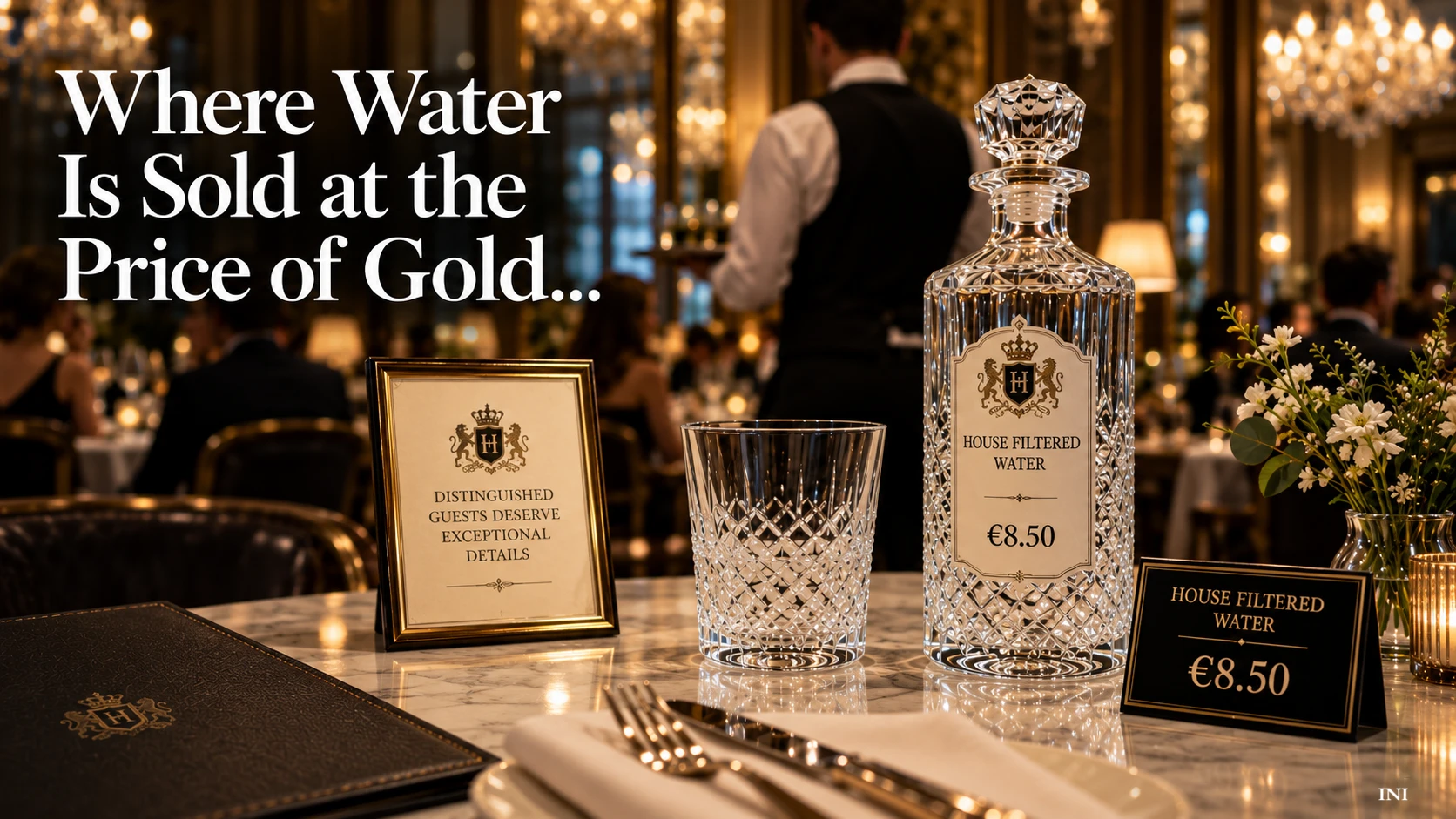
Because we like the ordinary to arrive dressed as luxury. We like the bottle, the crest, the exclusive label, and the typeface that suggests this is not something to drink, but something to be seen drinking.
At that moment, there is no longer water in the glass. There is the pleasant illusion that we are more refined, healthier, and just a little more exceptional than those who merely wanted to quench their thirst.
“House filtered water.”
In plain English:
tap water has completed an MBA.
This is where the trick becomes almost beautiful.
Because while the world talks endlessly about sustainability, awareness, and responsible consumption, we are slowly reaching the point where asking for a large glass of plain tap water has become a small act of social resistance.
Not loud.
Not revolutionary.
Not dramatic.
Just this:
— Thank you, the unbranded version from the tap will do.
And today, that is a dangerous sentence.
Because the system does not like it when you need something.
It likes it when you feel uncomfortable not paying for it.
Water has therefore become a perfect symbol of our age.
A person walks in for a drink and walks out with an entire lesson in economic philosophy.
Unfortunately, that too may soon be added to the bill.
And so this would have remained a neat little theory — had the same scene not repeated itself yesterday in another place.
Different table.
Different waiter.
Different receipt.
The same sentence:
— We have filtered water.
That is when one understands that this is no longer a misunderstanding. Not an overenthusiastic owner. Not a badly written menu.
It is a practice.
Tap water has not disappeared.
It has simply been removed from the list of available choices.
And somewhere, in a business plan, this is probably called:
“Customer Experience Enhancement.”
Comments
Loading comments…