
“In the long run we are all dead.”
— John Maynard Keynes
There is something reassuring about the long term.
It is spacious, quiet and, perhaps most importantly, rarely demands anything of us by three o’clock this afternoon.
People grow fond of it rather quickly.
If something is not working, in the short term it is naturally inconvenient. In the long term, however, it tends to become a strategic issue. It is discussed in a different tone, placed in a strategic document, given a timeline and several target dates, and although the problem itself remains exactly where it was, it now looks considerably more professional.
Economics is particularly good with time.
There is the short term, the medium term, the long term, the cycle, the correction, the equilibrium and the adjustment. Occasionally, one gets the impression that if everyone waits patiently enough, the system will eventually become slightly embarrassed and correct its own mistakes.
The only question is who has to wait that long.
That does not always appear in the model.
There is demand, supply, consumption, investment, inflation and growth. People mostly appear as variables, preferably reduced to figures civilised enough to fit neatly into a spreadsheet.
Reality is somewhat less orderly.
There is a kitchen table with a bill on it that cannot really be paid from a long-term perspective. There is a home that needs heating now, a pension that has to last through this month, and a pothole that has not read the government’s economic programme and has therefore remained where it was.
The present has one irritating quality: it is physical.
It is not terribly interested in what the forecast says.
People usually notice this when someone asks them to be patient.
Patience is a great virtue in economic policy, particularly when somebody else is expected to practise it.
Reforms take time. Investments pay off later. Structural change becomes visible only after several years. The new system is suffering from teething problems, while the problems of the old system were inherited.
Everything has its proper time. Only the present somehow keeps getting trapped between two explanations.
What feels like a loss today can then be reclassified as a temporary adjustment cost. This is undoubtedly much more reassuring.
Especially for whoever is not footing the bill.
“Eventually” is a curious refuge. It does not deny that there is a problem. It merely relocates it to a point in time at which nobody is yet demanding an answer. Once the future enters the sentence, the losses of the present can more easily become transitions, necessary corrections or the cost of some larger process.
Whatever happens in the meantime naturally remains part of the present.
Economic theory likes equilibrium. Life is less patient.
Equilibrium does not arrive politely at the door, remove its coat and apologise for being late. If it emerges at all, it generally requires decisions, mistakes, losses, compromises and people.
Or it does not emerge.
In which case another report is commissioned.
One of the great advantages of the long term is that it has very few witnesses.
A ten- or twenty-year target is an elegant thing. Ambitious enough to look impressive on the first slide of a presentation, yet distant enough for the moment of accountability to fall several electoral, corporate or management cycles into the future.
The future is an exceptionally cooperative audience.
It does not interrupt speeches, ask awkward follow-up questions or send irritated emails at half past nine in the evening. This makes the future an excellent place to leave pensions, climate targets, public debt, infrastructure, education and healthcare — almost anything for which it would be uncomfortable, in the present, to decide who will pay, who will give something up and who should finally admit that the current arrangement is not working.
The long term carries these burdens remarkably well.
On paper, at least.
Of course, people understand that some things cannot be fixed overnight. An economy is not a washing machine on which one merely selects the correct programme. Pension systems, energy supply and education really do take decades to change.
That is precisely why the long term makes such a convenient hiding place.
Reasonable explanations and comfortable excuses often use exactly the same vocabulary.
Strategy.
Gradualism.
Sustainability.
Competitiveness.
Transition.
After listening to them for long enough, a person eventually wants to know when any of this will become noticeable on a Monday morning.
The answer is usually more complicated than that.
This, too, is one of the more impressive achievements of modern economic messaging: the simpler a person’s problem, the more sophisticated the explanation can become for why it cannot be solved now.
A family asks why the same life costs more.
The answer may involve the global economic environment, monetary transmission, productivity, geopolitical uncertainty and medium-term adjustment.
All of that may be true.
The bill does not get any smaller.
This is not really the fault of economics. Economics is at least attempting to describe a system that people, meanwhile, continue to complicate with considerable enthusiasm.
The problem begins when explanation slowly takes the place of remedy. When understanding why something is happening starts to feel almost equivalent to changing it.
People recognise this from smaller matters. They know exactly why they should exercise more, spend less or go to bed earlier.
Understanding is a magnificent state.
It simply burns surprisingly few calories.
In economic policy, much the same thing happens on a somewhat larger and more expensive scale. There is a diagnosis, a strategy, a roadmap, a review, an action plan and, eventually, another roadmap.
The process is moving forward.
At least in the documentation.
And this is where things become more personal, because this fondness for the long term is not confined to governments, banks and institutions.
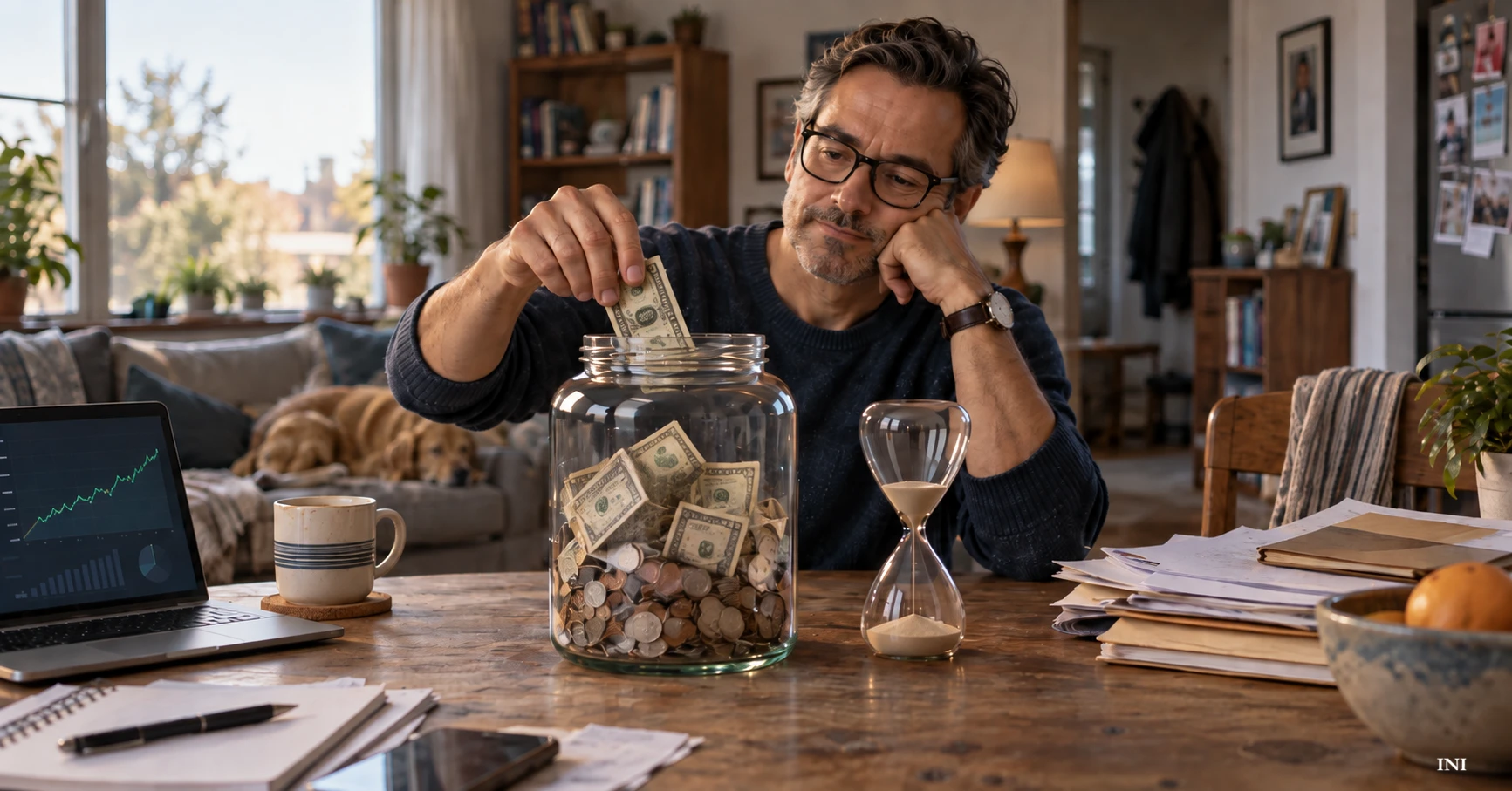
We entrust quite a lot of our own lives to the future as well. We work now so that we can relax later. We save so that we can feel secure later. We invest so that the money we have saved does not merely sit there, but works diligently on our behalf. If things go well, we reinvest the returns too.
At this point, money is no longer simply money. It has been given a task.
It must grow.
At first, our savings represent a few months of security. Entirely sensible. Then perhaps a year would be better. Later, a little more still, because by then we have learned just how many things can go wrong.
Uncertainty is an unusual financial adviser.
It rarely tells us when enough is enough.
“Enough” is, in any case, an inconveniently imprecise economic category. It is difficult to graph, has no universally accepted benchmark and displays a remarkable tendency to increase alongside wealth.
When we have little, we want a little more. Once we have a little more, we want security. Once we have security, we want to preserve it. And preservation requires growth, because there is inflation, risk, the market, and somewhere there is almost certainly a better return.
So we start watching shares, bonds, interest rates, property prices and exchange rates.
After a while, we no longer check the account because there is something we wish to buy. It simply feels good to see the number increase.
The number slowly acquires a life of its own.
Once, it was a means by which we might eventually do something. Later, the growth itself becomes what we are doing.
There is nothing particularly immoral about this. Saving is sensible. A reserve provides freedom. Investing is often more rational than allowing money to lose value slowly in an account.
Sometimes the boundary between security and postponement begins to blur.
We save for a better future, then become so successful at protecting the money from that future that the two fail to meet for a very long time.
Not yet. Later. When there is more. When things are safer. When the market settles. When the exchange rate improves. When this cycle ends. When a certain figure has been reached.
The figure, naturally, changes from time to time.
Meanwhile, we grow slightly older.
Speculation merely makes the arrangement more elegant.
We sit in front of a screen analysing a company’s growth prospects for 2045. This may be entirely rational, although the portfolio’s investment horizon can sometimes be rather more optimistic than our own biology.
Financial analysis is generally tactful enough not to mention this.
Compound interest really is a wonderful thing.
Time works for us.
But it works on us too.
Perhaps that is what makes the relationship between money and life so peculiar. We spend a substantial part of our time acquiring money, then preserve a substantial part of that money in the hope that one day we will be able to buy back some of our time.
To be freer.
To work less.
To travel.
To read.
To sit somewhere quietly.
The trouble is that “one day” suffers from the same weakness as every distant promise: it has no fixed date.
There is always room before it for another year, another project, another investment opportunity or a more favourable moment.
The future remains patient.
We are less so.
And this is where the logic of the long term becomes genuinely uncomfortable.
We know that our own time horizon is not unlimited. Yet we rarely incorporate that fact into our financial planning with quite the same discipline we apply to inflation, expected returns or risk tolerance.
In our financial plans, we tend to treat ourselves as unexpectedly durable assets.
A portfolio has an expected return, savings have a target value, retirement has a date.
Life comes with a less precise prospectus.
Perhaps the question is not why we save when our time is finite. That would be too easy a question, and it would probably lead to rather poor financial advice.
The more interesting question is when preparing for the future becomes so successful that life itself ends up on the waiting list.
When is the reserve enough? When is the return enough? And when exactly does the future arrive for which we have spent so many years making room?
There may be no universal answer.
There is simply something peculiar about spending an entire life saving for freedom later, while every passing year leaves a little less of “later” behind.
The long term is important.
It has simply become a rather comfortable place for everything we do not want, do not dare or do not yet feel sufficiently justified in doing in the present.
And we, meanwhile, continue to live in the short term.
We wake up, work, pay, save, invest, wait, and try to decide which future is still worth preparing for.
Every so often, it may be worth remembering what we intended to do with all that carefully saved time.
Comments
Loading comments…